

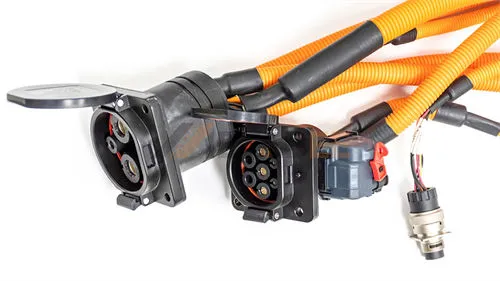
CCS is one of the most widely used EV charging systems for AC charging and DC fast charging. However, CCS is not a single connector design. CCS1 and CCS2 use different AC interfaces and serve different regional markets, while sharing the same basic combined charging concept.
This difference matters when selecting a charging connector, vehicle inlet, or charging cable. A CCS connector designed for one market cannot simply be treated as interchangeable with the other.
This guide compares CCS1 vs. CCS2 in connector design, pin configuration, charging capabilities, regional adoption, and compatibility, helping you identify the right CCS solution for your EV charging application.
What Is CCS Charging?
The Combined Charging System (CCS) is an EV charging standard that combines AC charging and DC fast charging in a single connector system. By adding dedicated DC power contacts to the existing AC charging interface, CCS allows electric vehicles to support both everyday charging and high-power fast charging through one charging port.
A CCS connector typically consists of three main parts:
- AC charging contacts — used for standard AC charging
- DC power contacts — used for high-power DC fast charging
- Communication contacts — enable data exchange between the vehicle and charger
This integrated design makes CCS one of the most widely adopted EV charging systems worldwide.
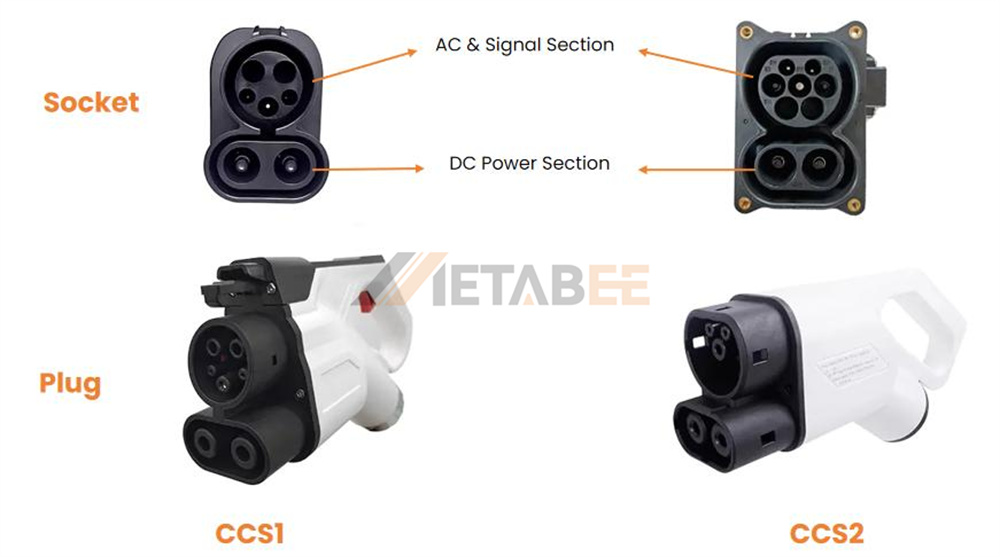
CCS1 vs CCS2 Sockets and Plugs
Why Are There CCS1 and CCS2?
CCS1 and CCS2 are not separate charging systems. They are two configurations based on the same Combined Charging System (CCS) concept. The main reason for these two versions is that different regions adopted different AC charging interfaces.
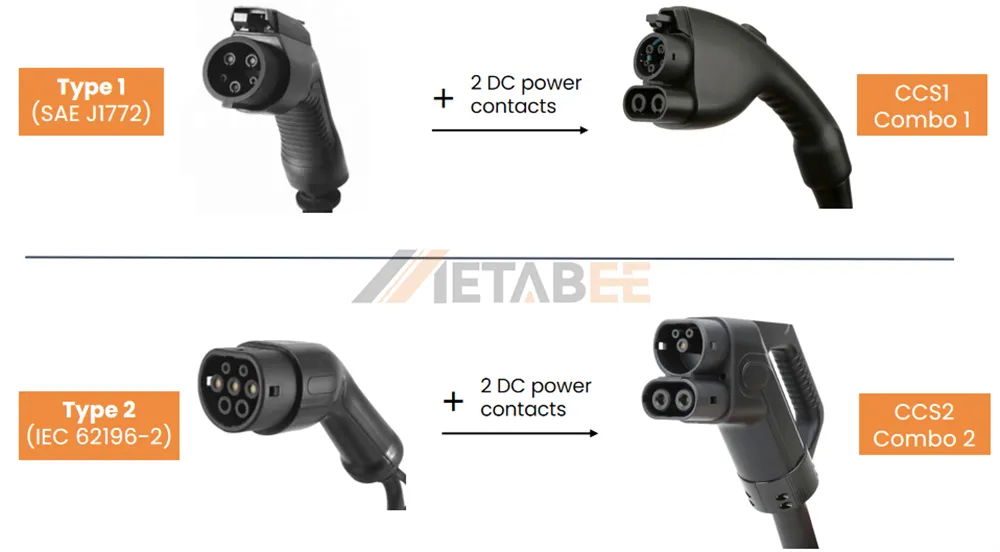
When CCS was developed, it was designed to add DC fast charging capability to existing AC charging standards:
- Type 1 AC interface + DC contacts → CCS1
- Type 2 AC interface + DC contacts → CCS2
CCS1 is based on the Type 1 (SAE J1772) AC interface and was mainly developed for the North American market. CCS2 is based on the Type 2 (IEC 62196-2) AC interface and became widely adopted in Europe and many other global markets.
How Does CCS Charging Work?
CCS charging works through communication between the electric vehicle and charging equipment before power delivery begins.
The basic charging process includes:
1.Connection
The EV is connected to the charging station using a CCS connector.
2.Communication
The vehicle and charger exchange information to confirm charging requirements and safety conditions.
3.Power delivery
The charging system supplies power based on the vehicle’s charging capability.
4.Charging management
The battery management system controls charging parameters to ensure safe and efficient operation.
CCS supports two charging methods:
- AC charging: The vehicle’s onboard charger(OBC) converts AC power into DC power for the battery.
- DC fast charging: The charger delivers DC power directly to the battery through the DC contacts, enabling higher charging speeds.
Through this integrated design, CCS provides a flexible charging solution for different EV applications, from daily charging to high-power fast charging.
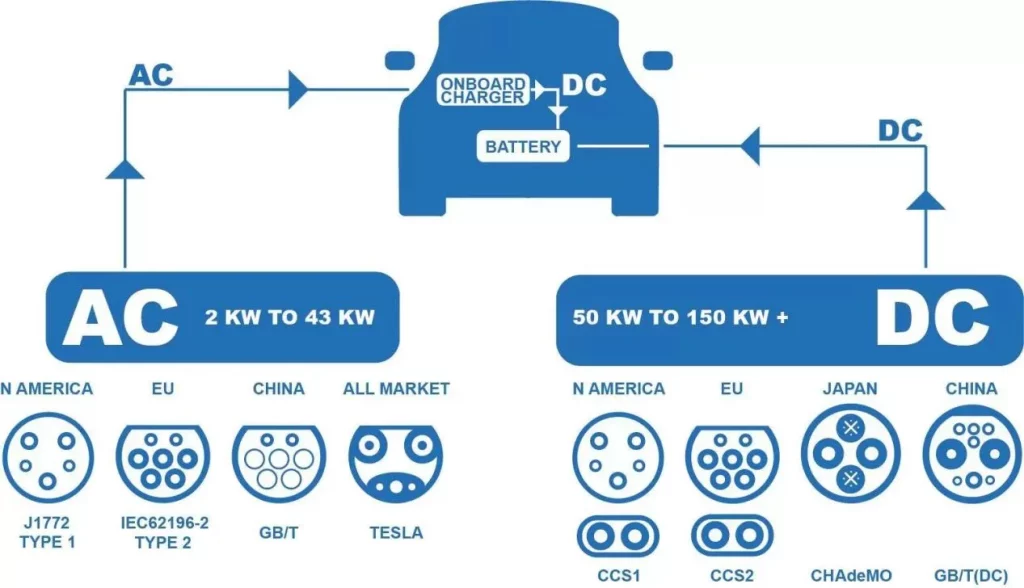
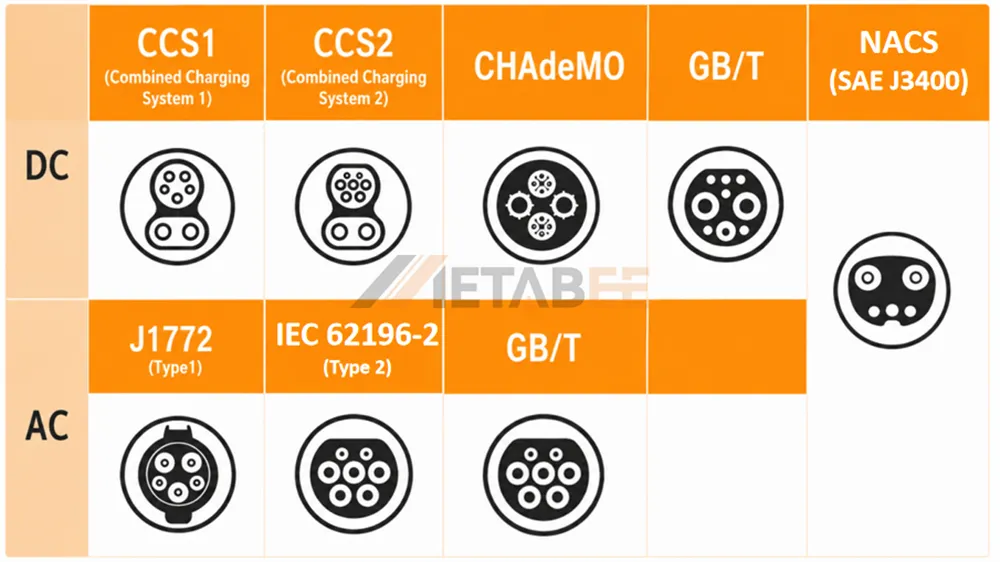
Major EV charging connector systems
| Charging system / interface | Main charging type | Typical market or association |
|---|---|---|
| SAE J1772 / Type 1 | AC | North America |
| IEC 62196-2 / Type 2 | AC | Europe and many other markets |
| CCS1 / Combo 1 | AC + DC | North America |
| CCS2 / Combo 2 | AC + DC | Europe and many other markets |
| GB/T AC | AC | China |
| GB/T DC | DC | China |
| CHAdeMO | DC | Japan and other markets |
| NACS / SAE J3400 | AC + DC | North America |
This table reveals an important point: CCS is not simply another name for an EV charging plug. It is a combined charging system built around a specific connector architecture.
CCS1 vs. CCS2: What Is the Difference?
CCS1 and CCS2 share the same combined charging concept, but they differ in their AC interface, connector configuration, AC charging capability, and regional adoption. These differences affect the physical design of the CCS charging connector and determine which connector configuration fits a specific vehicle and market.
The table below provides a quick comparison before we look at the connector structure and electrical specifications in detail.
CCS1 vs CCS2: Key Differences
| Feature | CCS1 | CCS2 |
| Also called | Combo 1 | Combo 2 |
| AC interface | Type 1 | Type 2 |
| AC phase configuration | Typically single-phase | Single-phase or three-phase |
| DC charging | Yes | Yes |
| DC power contacts | 2 (DC+ / DC−) | 2 (DC+ / DC−) |
| Locking Mechanism | Mechanical latch on the plug handle | Motorized internal locking pin in the vehicle inlet |
| Main regional association | North America; also used in South Korea | Europe and many other markets |
| Combined connector | Type 1 + DC section | Type 2 + DC section |
The most important difference is the AC interface. CCS1 uses a Type 1-based configuration, while CCS2 uses a Type 2-based configuration. Both add two dedicated DC power contacts to the lower part of the connector, allowing the same combined connector design to support DC charging.
This difference also explains why CCS1 and CCS2 have different pin layouts and why CCS2 can support three-phase AC charging.
Connector Design and Pin Configuration
The pin configuration of CCS1 and CCS2 differs mainly in the AC power contacts. CCS1 uses L1 and N, while CCS2 adds L2 and L3 to support three-phase AC charging.
| Pin / Contact | CCS1 | CCS2 | Function |
| L1 | ✓ | ✓ | AC line |
| L2 | — | ✓ | AC line for three-phase charging |
| L3 | — | ✓ | AC line for three-phase charging |
| N | ✓ | ✓ | AC neutral |
| PE | ✓ | ✓ | Protective earth |
| CP | ✓ | ✓ | Charging control and communication |
| PP | ✓ | ✓ | Proximity detection and cable identification |
| DC+ / DC− | ✓ | ✓ | DC power |
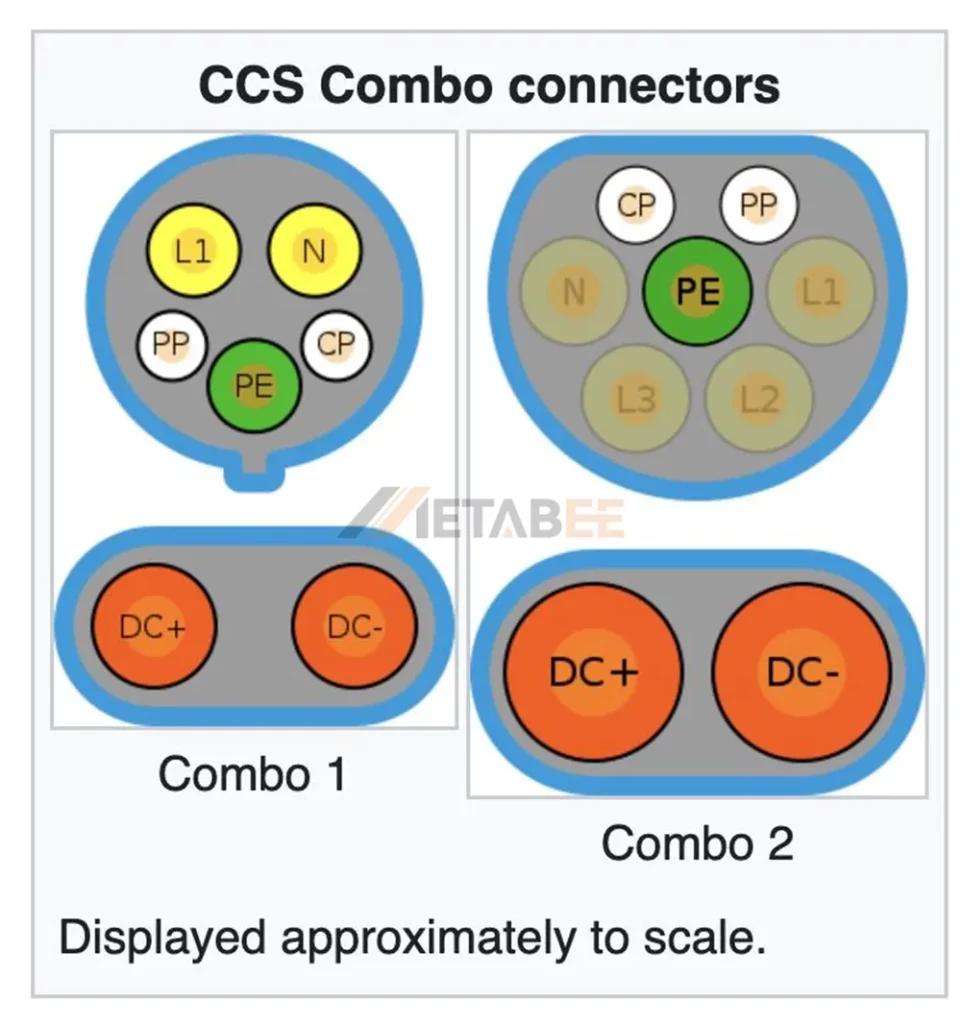
The L1 and N contacts form the AC power circuit in CCS1. CCS2 adds L2 and L3, providing the additional AC lines required for three-phase charging. As a result, CCS1 typically supports single-phase AC charging, while CCS2 can support either single-phase or three-phase AC charging when the vehicle and power supply allow it.
CP (Control Pilot) manages communication and charging control between the EV and charging equipment. PP (Proximity Pilot) detects the connector connection and provides cable-related information.
For DC charging, DC+ and DC− carry the DC power from the charging equipment to the vehicle. Their function is the same in both CCS1 and CCS2.
Key Difference
- CCS1: L1 + N → single-phase AC
- CCS2: L1 + L2 + L3 + N → single-phase or three-phase AC
The most significant pin-level difference is therefore L2 and L3. Their presence in CCS2 enables three-phase AC charging, while the CP, PP, and DC power contacts serve the corresponding control, connection, and DC charging functions in both configurations.
Charging Power and Electrical Specifications
CCS1 and CCS2 have their biggest difference in AC charging capability. CCS1 is based on the Type 1 AC interface and supports single-phase AC charging, while CCS2 is based on the Type 2 AC interface and supports both single-phase and three-phase AC charging. This gives CCS2 greater flexibility for AC charging.
Does CCS2 Charge Faster Than CCS1?
For AC charging, CCS2 can be faster than CCS1 because it supports three-phase charging. However, the actual charging speed still depends on the vehicle’s onboard charger and available power supply.
For DC fast charging, CCS1 and CCS2 do not have a fundamental difference in charging capability. Both connectors use dedicated DC+ and DC− contacts to deliver power directly to the vehicle battery.
- Charging power (W) = Voltage (V) × Current (A)
The actual DC charging performance depends on the complete charging system, including the EV battery, charging station, cable assembly, and connector design
For CCS charging connectors and cable assemblies, key factors affecting charging performance include:
- Rated voltage and current — determine the maximum power capability.
- Cable conductor size — affects current capacity and heat generation.
- Temperature monitoring and cooling design — help maintain safe operation during high-power charging.
In summary, CCS2 does not charge faster simply because of its connector design. Its main advantage is greater AC charging flexibility through three-phase charging, while both CCS1 and CCS2 can support high-power DC fast charging when paired with suitable vehicles and charging equipment.
Key Electrical Specifications Comparison
| Parameter | CCS1 (Combo 1) | CCS2 (Combo 2) |
| Applicable Standards | SAE J1772, IEC 62196-3 | IEC 62196-2, IEC 62196-3 |
| Grid Configuration | 1-Phase AC | 1-Phase & 3-Phase AC |
| Max AC Power (Theoretical) | Up to 19.2 kW (80A @ 240V) | Up to 22 kW (32A @ 400V) / 43.5 kW (63A) |
| Typical AC Power (Passenger EV) | 7.4 kW – 11.5 kW | 11 kW – 22 kW |
| Max DC Rated Voltage | Up to 1000V DC | Up to 1000V DC |
| Max DC Continuous Current | 200A – 250A (Uncooled) / 500A (Liquid-Cooled) | 200A – 250A (Uncooled) / 500A (Liquid-Cooled) |
| Peak DC Fast Charging Power | Up to 350 kW – 500 kW | Up to 350 kW – 500 kW |
| Communication Protocol | PLC (ISO 15118 / DIN 70121) | PLC (ISO 15118 / DIN 70121) |
Regional Adoption
The adoption of CCS1 and CCS2 varies by region, mainly due to differences in charging infrastructure and vehicle markets.
CCS1 Adoption
CCS1 is mainly used in North America, including the United States and Canada. It is commonly found in EVs and charging stations that follow the SAE J1772 Type 1 charging standard.
CCS2 Adoption
CCS2 is widely adopted in Europe, Australia, New Zealand, and many other markets. Its support for three-phase AC charging makes it well suited to regions where three-phase power is commonly available.
Which CCS Standard Is More Common Globally?
Currently, CCS2 has broader adoption across global EV markets, especially in Europe and many emerging EV markets. However, CCS1 remains an important standard in North America.
For EV charging connector manufacturers and suppliers, selecting CCS1 or CCS2 depends mainly on the target market, vehicle compatibility requirements, and local charging infrastructure.
CCS1 vs CCS2 Compatibility
Can CCS1 and CCS2 Be Used Interchangeably?
No. CCS1 and CCS2 cannot be connected directly without additional equipment.
The main reasons for incompatibility are as follows:
- Physical Housing & Locking: CCS1 is based on the 5-pin Type 1 shape with an external thumb-latch handle, while CCS2 uses the 7-pin Type 2 shape designed for an internal vehicle motorized lock.
- Electrical Pin Configuration: CCS1 carries single-phase AC contacts (L1 + N), whereas CCS2 incorporates three-phase AC contacts (L1 + L2 + L3 + N).
Can an Adapter Connect CCS1 and CCS2?
Yes. However, the adapter solution depends entirely on whether you need AC destination charging or DC fast charging.
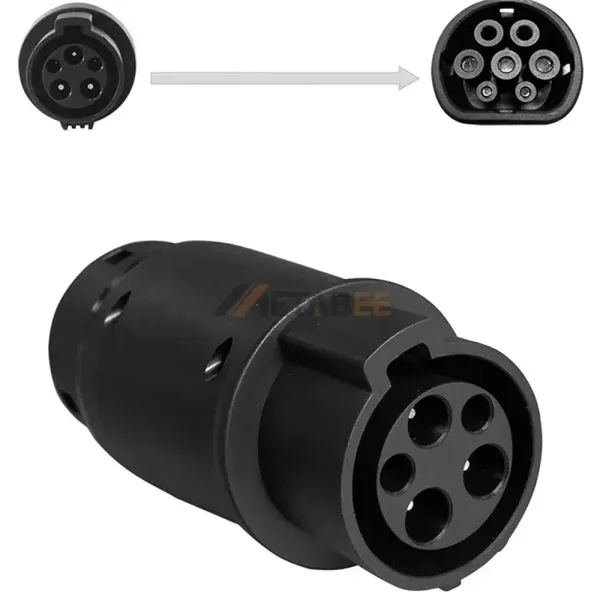
- AC Charging Adapters (Slow / Destination Charging)
For AC charging at home or public stations, you can use basic Type 1/Type 2 adapters. They support single-phase power up to 7.4 kW.
- DC Fast Charging Adapters (High-Power Solutions)
DC fast charging delivers high-voltage direct current straight to the traction battery. Bridging CCS1 and CCS2 for DC fast charging requires certified, high-grade hardware built to the IEC 62196-3 standard.
Professional manufacturers offer two primary DC adapter configurations:
- Compact Direct-Plug Adapters: A direct, rigid adapter without intermediary cables. Its compact form factor makes it easy to store in the vehicle for roadside DC fast charging.
- Flexible Cable-Type Adapter Assemblies: A heavy-duty flexible cable links the plug and socket with integrated handles. This layout relieves mechanical downward torque on the vehicle inlet, protecting the car’s charging port during high-current sessions.
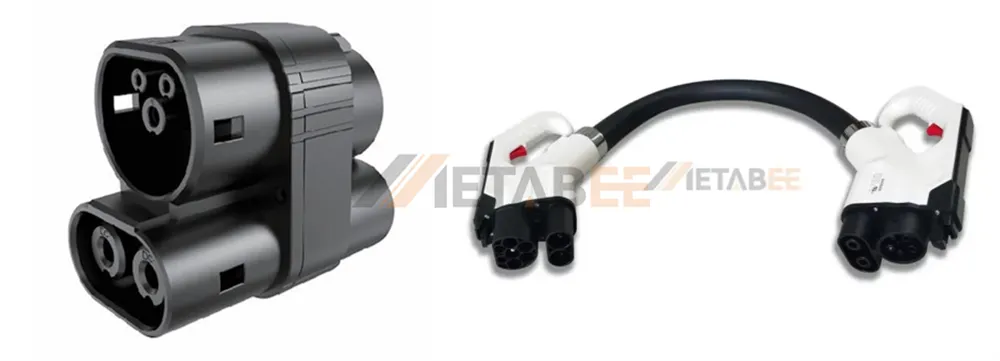
To support diverse vehicle setups and international markets, our Metabee brand provides a versatile portfolio of certified EV charging adapters. From lightweight AC converters to industrial direct-plug and cable-type DC adapters, our solutions ensure safe and reliable charging compatibility across global networks.
How to Choose Between CCS1 and CCS2 Connectors?
Choosing between CCS1 and CCS2 depends on the target market, vehicle compatibility, and charging requirements. Neither standard is universally better; the right choice depends on the application.
1.Target Market
CCS1: Mainly used in North America and regions based on the Type 1 AC interface.
CCS2: Widely adopted in Europe and many global markets using the Type 2 AC interface.
2. Vehicle and Charging Compatibility
Before selecting a CCS connector, confirm:
- Vehicle inlet type
- Charging station interface
- Local charging standards
3. Charging Requirements
For high-power charging applications, consider:
- Rated voltage and current
- Cable size
- Cooling and temperature management
The right CCS connector should match the complete charging system to ensure safe and reliable operation.
CCS vs NACS vs CHAdeMO
Beyond CCS, the global EV market features two other well-known charging standards: Tesla’s NACS and Japan’s CHAdeMO.
Understanding these EV charging standards helps you see where the industry is heading.
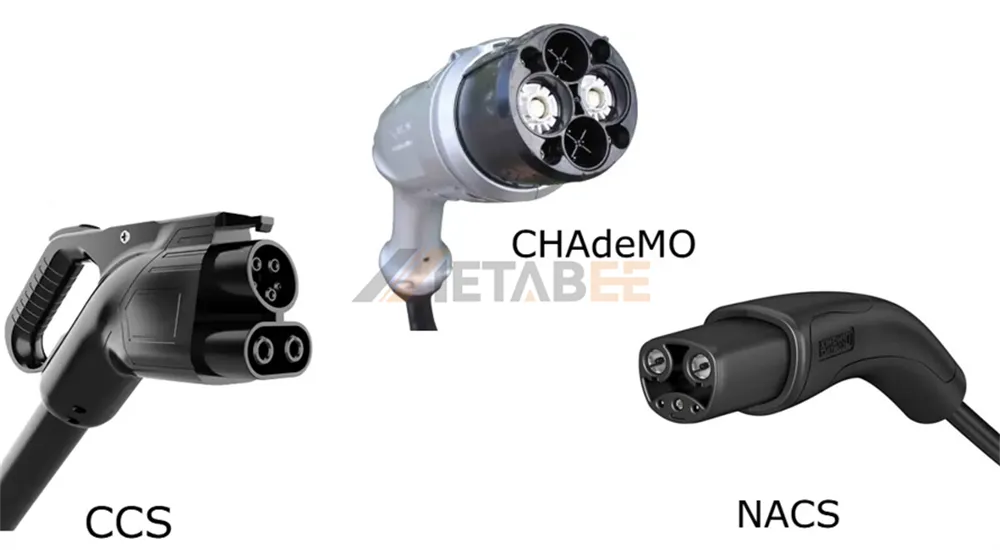
1. CCS vs NACS
Originally designed by Tesla, the North American Charging Standard (NACS) uses a compact, lightweight plug that handles both slow AC charging and high-power DC fast charging through the same pins. While NACS is the widely used commercial name, it has been officially standardized by SAE International as SAE J3400, establishing an open technical standard for all manufacturers.
- Plug Size: The NACS plug is much smaller and lighter than both CCS1 and CCS2 plugs.
- North American Trend: Most major automakers in North America (including Ford, GM, and Hyundai) are adopting NACS for their upcoming vehicles.
- Global Situation: NACS is mainly used in North America. In Europe and Australia, all Tesla cars and Superchargers use standard CCS2 connectors.
2. CCS vs CHAdeMO
Developed in Japan, CHAdeMO was the first widely deployed fast-charging system.
- Dual-Port Clutter: CHAdeMO handles DC fast charging only. EVs using CHAdeMO must install a second, separate port on the car body for everyday AC charging. In contrast, CCS combines AC and DC charging into a single, clean vehicle inlet.
- Market Outlook: Except for a few models like the Nissan LEAF, CHAdeMO is steadily disappearing outside Japan. Most modern EVs now use CCS2 or NACS.
While these standards feature different physical connectors, certified EV charging adapters make cross-charging possible. With the right adapter, drivers can easily switch between NACS and CCS networks, bridge imported CCS1 and CCS2 vehicles, or connect legacy CHAdeMO cars to modern DC fast-charging stations.
Conclusion
CCS1 and CCS2 are both based on the Combined Charging System (CCS), but they are designed for different regional charging requirements.
The main difference is their AC charging interface: CCS1 uses the Type 1 interface and is mainly used in North America, while CCS2 uses the Type 2 interface and is widely adopted in Europe and many other global markets. For DC fast charging, both CCS1 and CCS2 can support high-power charging when the vehicle, charger, and cable assembly meet the required specifications.
CCS1 and CCS2 cannot be directly connected due to differences in connector design and charging interfaces. However, compatible adapters can enable cross-standard charging in specific applications.
There is no universally better option between CCS1 and CCS2. The right choice depends on the target market, vehicle compatibility, charging requirements, and application environment.
Metabee provides a range of EV charging connector solutions, including CCS charging connectors and related cable assemblies, supporting different market requirements and customized applications. If you need help selecting the right CCS connector solution for your project, please contact our engineering team for professional support.
Related products
CCS Combined Charging System Connectors
FAQs
Q1: Is CCS2 faster than CCS1?
A: Not necessarily. Charging speed depends on the vehicle, battery, charger, voltage, current, cable, connector, and thermal system. The CCS1 or CCS2 designation alone does not determine charging speed.
Q2: Can CCS1 and CCS2 be used together?
A: They are not directly interchangeable because their physical interfaces differ. An adapter may support certain applications, but mechanical, electrical, communication, and safety compatibility must all be verified.
Q3: What is the difference between CCS and NACS?
A: CCS uses CCS1 or CCS2 configurations with a combined AC/DC connector architecture. NACS uses a more compact combined connector and is standardized in North America under SAE J3400.
Q4: Are CCS connectors waterproof?
A: Yes. CCS connectors are designed for outdoor charging environments and include sealing structures to protect against moisture and dust. The actual protection level depends on the connector design, housing structure, and certification requirements.
Q5: Will CCS2 replace CCS1 in the future?
A: CCS2 has wider adoption globally, especially in Europe and many emerging EV markets. However, CCS1 remains widely used in North America, so both standards will continue to exist depending on regional charging infrastructure and vehicle requirements.
