
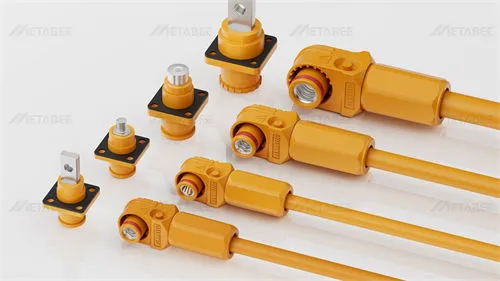
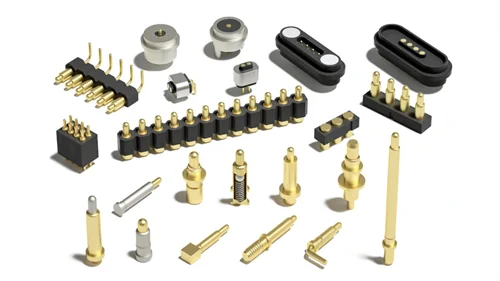
In North America, SAE J1772 and NACS (SAE J3400) are two main interfaces used across passenger electric vehicles and charging infrastructure. SAE J1772 has traditionally served as the standard residential and commercial AC charging interface for EVs. NACS is also an important EV charging interface with its compact design and compatibility with AC and DC charging.
Understanding these differences helps engineers select suitable charging interfaces. It also helps procurement teams evaluate connector specifications, compatibility requirements, and long-term supply considerations. This article compares NACS and J1772 across seven technical areas. It also explains how CCS1 relates to J1772 and examines the future direction of North American EV charging standards.
What Is a NACS Connector (SAE J3400)?
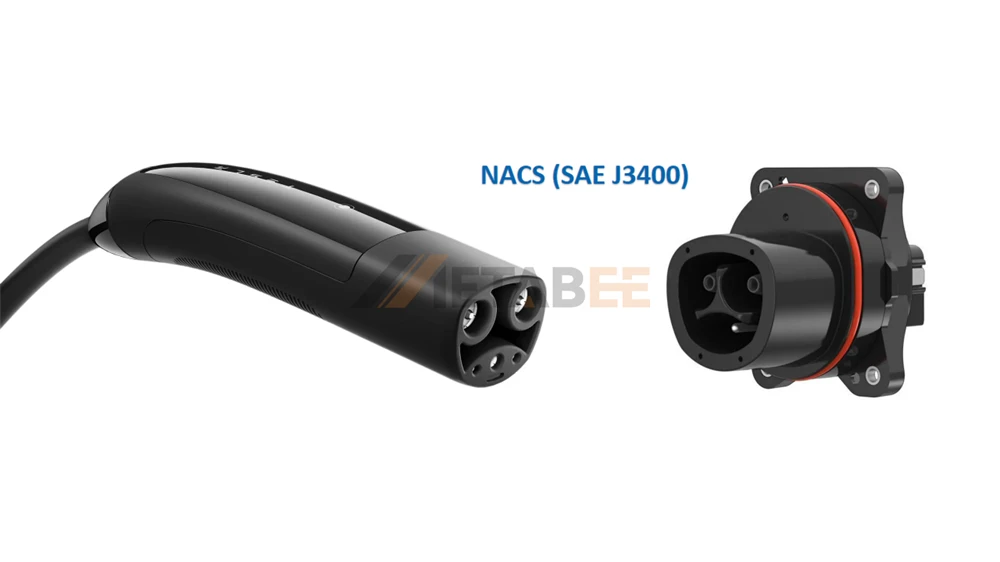
A NACS (SAE J3400) connector is a compact EV charging connector that supports both AC and DC charging through a single plug. NACS stands for North American Charging Standard. Tesla introduced the interface in 2012 for its electric vehicles and Supercharger network. The design aimed to support both AC charging and DC fast charging through a single compact port. In November 2022, Tesla opened the technical specifications to third-party manufacturers. SAE International subsequently standardized the interface under the formal designation SAE J3400.
Key Features
- Compact physical design: The connector has a smaller form factor than the J1772 connector with its separate CCS1 DC extensions.
- AC and DC compatibility: One connector supports AC Level 1, AC Level 2, and DC fast charging.
- Vehicle-controlled locking: The locking mechanism engages through the vehicle inlet rather than a manually operated connector latch.
- Standardized communication: The interface supports established charging communication methods, including power-line communication and optional LIN-based signaling.
- High electrical capability: J3400 supports DC supply voltages up to 1,000 V. Current capability can reach 1,000 A with appropriate thermal management.
What Is a J1772 Connector (SAE J1772)?
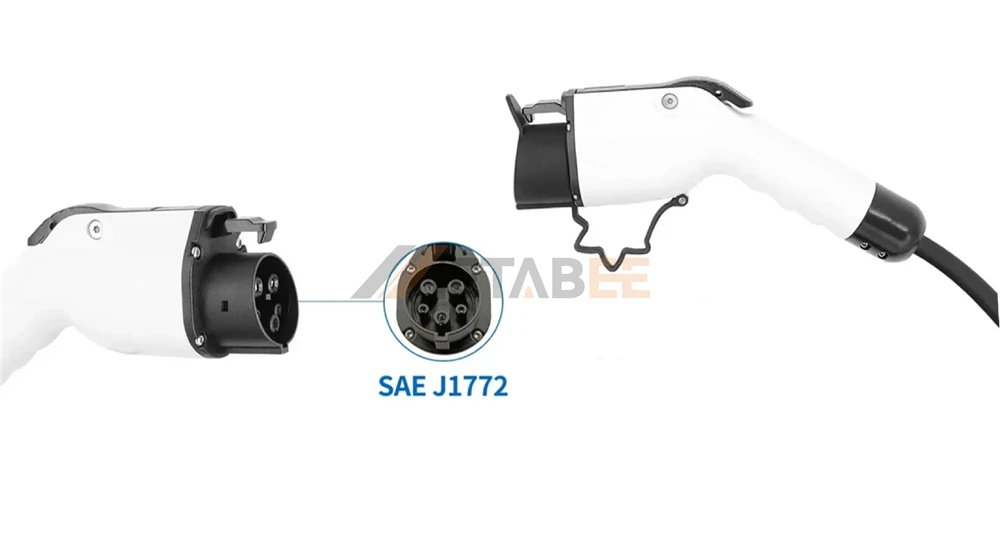
A J1772 (SAE J1772) connector is a standardized EV charging plug and support for AC Level 1 and Level 2 charging. SAE J1772 is an automotive charging standard developed by SAE International. It defines the physical interface and electrical signaling requirements for vehicle charging connections. The connector is commonly known as J plug or Type 1. It became a widely adopted interface for AC charging in North America. The standard became widely adopted as the AC charging interface for plug-in hybrid vehicles and battery electric vehicles.
Key Features
The SAE J1772 connector uses five electrical contacts with clearly defined functions.
- Five-contact configuration: Two AC power contacts, one protective earth contact, one control pilot contact, and one proximity contact.
- AC charging support: Compatible with Level 1 and Level 2 charging applications.
- Manual latch mechanism: A mechanical latch secures the connector to the vehicle inlet.
- Control pilot signaling: PWM signaling communicates charging availability and allowable current.
- Established infrastructure: Widely deployed in residential, workplace, and public charging systems.
NACS vs. J1772: Key Differences at a Glance
NACS and J1772 share several charging functions, but their physical interfaces and supported charging modes differ.
| Feature | NACS (SAE J3400) | J1772 (SAE J1772) |
| Original developer | Tesla | SAE industry standard |
| Pin Count | 5 Pins (2 Shared Power, 1 Ground, 2 Signal) | 5 Pins (2 AC Line, 1 Ground, 2 Signal) |
| Current Types Supported | AC (Single-Phase) & DC | AC Only (Single-Phase) |
| AC charging | Yes | Yes |
| DC fast charging | Yes | No, requires CCS1 extension |
| AC power contacts | 2 shared contacts | 2 dedicated AC contacts |
| Connector design | Compact, single interface | Larger AC connector |
| Connector locking | Vehicle-controlled locking mechanism | Manual connector latch withvehicle-side locking |
| Weight & Form Factor | Compact, lightweight, single-barrel | Bulky circular handle with top trigger latch |
| North American adoption | Increasing adoption | Extensive installed base |
7 Technical Differences Between NACS and J1772 Connectors
The following seven comparisons examine their key technical differences and practical implications for EV manufacturers and charging equipment suppliers.
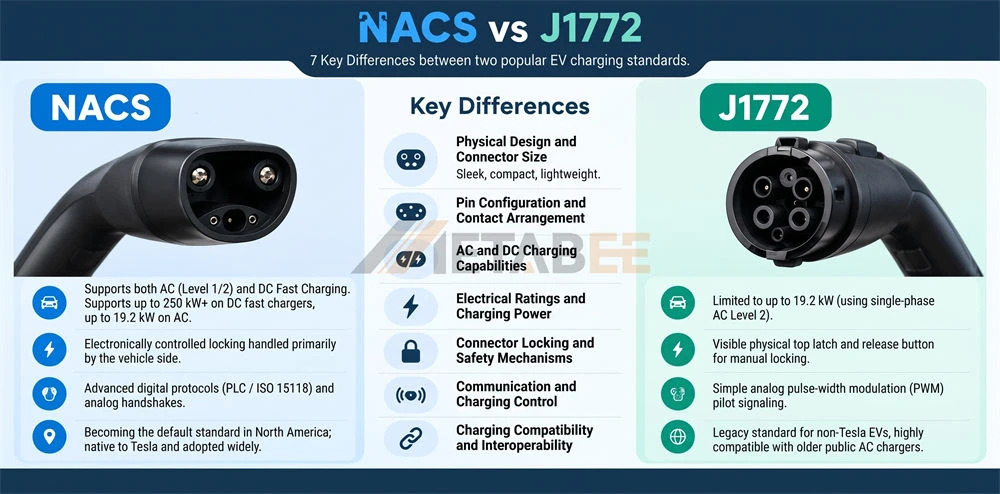
Physical Design and Connector Size
Physical design is one of the most noticeable differences between NACS and J1772 connectors.
- J1772 uses a larger connector housing with five contact positions. Its design accommodates AC charging and includes a mechanical latch on the connector handle. However, its design adds components to the connector housing and influences the required insertion and removal motion.
Pin Configuration and Contact Arrangement
Both connectors use five electrical contacts. However, they assign the main power contacts different roles during charging.
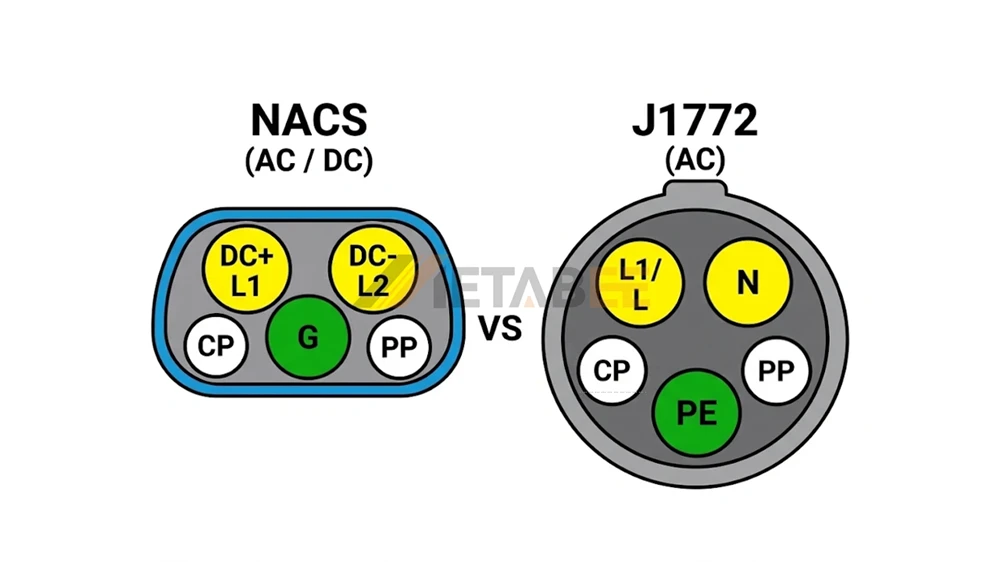
NACS contact configuration
NACS uses two large contacts for both AC and DC power transfer. Its remaining contacts handle protective grounding, control pilot signaling, and proximity detection.
Its five-contact arrangement includes:
- – Two power contacts for AC or DC energy transfer.
- – One protective ground contact.
- – One control pilot contact.
- – One proximity pilot contact.
This arrangement reduces the number of high-current contacts required within the connector. It also allows the same physical interface to support different charging modes.
J1772 contact configuration
The J1772 connector also uses five contact positions:
- – L1: First AC power conductor.
- – L2/N: Second AC power conductor or neutral, depending on the supply configuration.
- – PE: Protective earth.
- – CP: Control Pilot.
- – PP: Proximity Pilot.
AC and DC Charging Capabilities
Charging capability represents one of the most important differences between NACS and standalone J1772.
- NACS supports AC Level 1, AC Level 2, and DC fast charging through the same physical interfaces. It uses the same two main contacts for both AC and DC energy transfer.
- Standalone J1772 supports AC Level 1 and Level 2 charging. It does not provide dedicated high-current DC contacts.
Electrical Ratings and Charging Power
Voltage, current, and thermal performance determine the charging power a connector system can deliver.
- NACS supports a broad range of electrical configurations. The Joint Office identifies a maximum capability of up to 1,000 V DC and 1,000 A with appropriate liquid cooling.
- For J1772, Level 2 AC charging commonly operates at 208–240 V. The SAE J1772 ecosystem includes configurations supporting up to 80 A, subject to equipment and installation ratings.
The following table illustrates common charging configurations.
| Feature | NACS | J1772 |
| AC voltage | Depends on configuration | Typically 120–240 V |
| AC current | Depends on EVSE and vehicle | Up to 80 A in applicable configurations |
| DC voltage | Up to 1,000 V system capability | Not support |
| DC current | Up to 1,000 A with appropriate cooling | Not support |
| Charging power | Depends on voltage, current, and system limits | Up to 19.2 kW at 240 V and 80 A |
Looking for EV charging connectors with specific voltage and current ratings?
Contact Metabee with your electrical specifications to request product recommendations and a competitive quotation
Connector Locking and Safety Mechanisms
Connector locking prevents accidental disconnection during charging. Both interfaces provide mechanical retention, but their locking mechanisms operate differently.
- NACS removes the conventional finger-operated latch. Instead, a vehicle-controlled mechanical locking pin engages a recess in the connector housing. SAE J3400 requires locking during all types of energy transfer. The vehicle inlet controls the locking mechanism throughout the charging session.
For manufacturers, these differences affect inlet actuator design, connector retention testing, mechanical tolerances, and safety validation.
Communication and Charging Control
A charging connector does more than transfer electrical power. It also provides signaling functions that coordinate the EV and charging equipment.
- J1772 uses control pilot signaling with pulse-width modulation (PWM) to communicate charging status and maximum allowable AC current between the vehicle and EVSE, while the proximity circuit detects connector insertion and supports safe disconnection.
- SAE J3400 supports PWM control pilot signaling, power-line communication (PLC), and optional LIN communication over the control pilot (LIN-CP) for charging control and data exchange. It also supports ISO 15118-based functions, including Plug & Charge, provided that the vehicle, EVSE, communication software, and backend systems are properly configured.
Charging Compatibility and Interoperability
Charging compatibility depends on the vehicle inlet, charging station connector, adapter, and communication implementation.
- NACS vehicles can use compatible J1772 charging stations through an appropriate J1772-to-NACS AC adapter.
- Similarly, J1772-equipped vehicles can connect to NACS AC charging equipment through a suitable NACS-to-J1772 adapter.
- DC fast-charging compatibility requires separate consideration. A CCS1-equipped vehicle may use a compatible NACS charging station through an approved CCS1-to-NACS DC adapter.
The Joint Office recommends using appropriately certified adapters and following vehicle manufacturer instructions.
For charging station operators, supporting both NACS and CCS1 connectors can improve vehicle coverage during the transition between charging standards.
Need custom NACS-to-J1772 adapters, CCS1 charging cables, or other connector configurations?
Contact our technical team to discuss custom designs, cable specifications, and OEM requirements.
The Future of EV Charging: Will NACS Replace J1772?
NACS is becoming an important connector standard in North America. Major original equipment manufacturers have committed to deploying native J3400 ports on North American vehicles. Ford, General Motors, Hyundai-Kia, BMW, and Toyota have initiated this hardware transition.
However, the transition involves existing vehicles, charging infrastructure, and established equipment supply chains. Meanwhile, J1772 and CCS1 continue supporting a substantial installed base.
Vehicle manufacturers, charging network operators, component suppliers, and infrastructure developers must coordinate their equipment and technical requirements.
The future charging ecosystem will likely include native NACS systems alongside legacy J1772 and CCS1 equipment.
CCS1 vs J1772 : What’s the Difference?
NACS and J1772 comparisons often lead to confusion about CCS1. J1772 defines the AC charging interface. CCS1, also called SAE J1772 Combo 1, extends this interface with additional DC charging contacts.
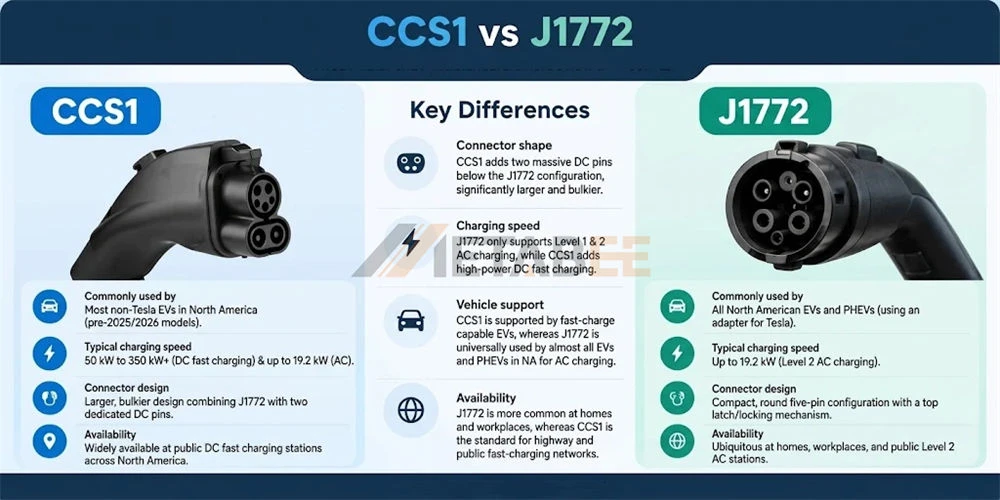
What Is CCS1 (SAE J1772 Combo 1)?
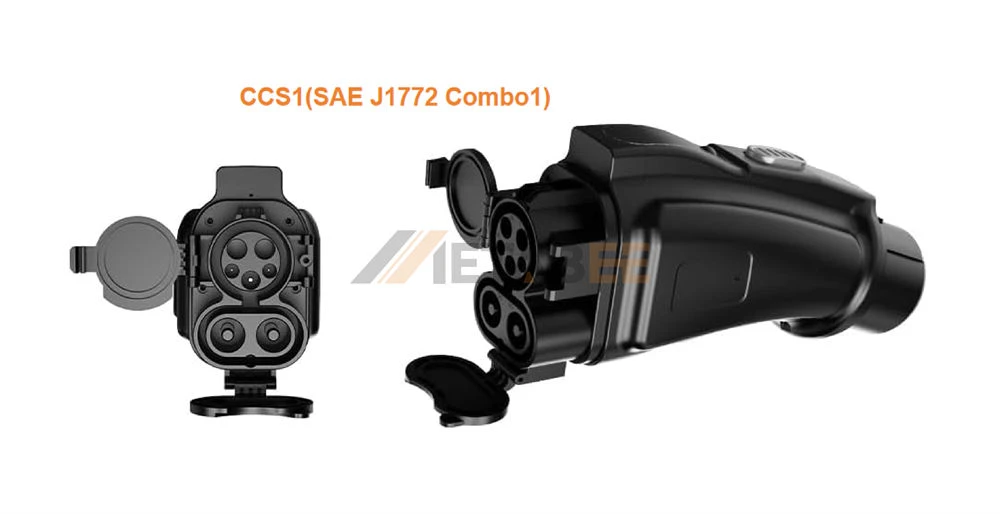
CCS1 stands for Combined Charging System 1. It is a North American charging interface that combines the J1772 AC connector arrangement with two additional DC power contacts.
The connector combines the standard J1772 five-contact upper section with two larger DC power contacts at the bottom. During AC charging, the interface uses the upper J1772 contacts. During DC fast charging, the two lower contacts carry DC power.
CCS1 became widely adopted by non-Tesla EV manufacturers in North America. It also formed the basis of much of the region’s early DC fast-charging infrastructure.
Technical Comparison
The main difference between CCS1 and standalone J1772 is DC charging capability.
| Feature | CCS1 | J1772 |
| Full designation | SAE J1772 Combo 1 | SAE J1772 Type 1 |
| Total contacts | 7 | 5 |
| AC charging | Yes | Yes |
| DC fast charging | Yes | No |
| AC power contacts | 2 | 2 |
| Additional DC contacts | 2 | No |
| Control pilot | Yes | Yes |
| Proximity detection | Yes | Yes |
| Main applications | AC charging and DC fast charging | AC Level 1 and Level 2 |
CCS1 retains the familiar J1772 upper interface. The additional DC contacts increase connector size but provide a dedicated high-current DC path.
How to Choose Between NACS and J1772 for EV Applications
The right interface depends on the intended application and the charging standards supported by the vehicle.
When to Choose NACS (SAE J3400)
NACS is suitable for applications requiring an integrated AC and DC charging interface.
Consider NACS when:
- – Developing new EV platforms for the North American market.
- -A compact connector and vehicle inlet design.
- -Integrated AC and DC charging through one interface.
- -Supplying components for J3400-compatible charging infrastructure.
- -Support for higher-voltage commercial AC charging applications..
NACS is particularly suitable for new passenger EV platforms targeting North American markets. However, engineers should confirm the required J3400 configuration, electrical ratings, and applicable safety certification before selecting components.
When to Choose J1772
J1772 remains suitable for applications focused on AC charging and compatibility with established North American infrastructure.
Consider J1772 when:
- -The vehicle platform already uses a Type 1 charging inlet.
- -The application requires AC Level 1 or Level 2 charging.
- -Existing charging stations use J1772 connectors.
- -The vehicle targets fleets with established J1772 infrastructure.
- -A new connector design would create unnecessary vehicle redesign costs.
- -The product must support compatibility with legacy charging equipment.
J1772 also remains relevant when developing CCS1 vehicle charging systems. CCS1 retains the J1772 contact arrangement for AC charging. For suppliers serving the aftermarket, J1772 components can remain important even as new vehicle platforms adopt NACS.
Key Factors to Consider When Selecting EV Charging Connectors
Before selecting a charging connector, engineering and procurement teams should evaluate several technical and commercial factors.
- Vehicle and Charging Infrastructure Compatibility
- Voltage and Current Requirements
- Thermal Management
- Mechanical Design and Installation Space
- Safety and Certification
- Communication and Interoperability
- Product Lifecycle and Procurement Cost
Have specific requirements for EV charging connector dimensions, current capacity, cable length, or materials?
Send your drawings or technical specifications to our technical team for a customized solution and quotation.
Conclusion
The growing adoption of SAE J3400 is driving a significant shift in the architecture of North American EV charging systems. Unlike the J1772/CCS1 connector configuration, SAE J3400 uses the same power contacts for both AC and DC charging, enabling a more compact connector design and simplifying vehicle inlet integration.
EV charging manufacturers and equipment suppliers capable of supporting both J3400 and J1772/CCS1 architectures will be better positioned to serve diverse vehicle platforms and charging infrastructure projects. For procurement teams, partnering with experienced manufacturers can help ensure product compatibility and maintain supply flexibility during the transition between charging standards.
Looking for an EV charging connector manufacturer?
Metabee offers a range of NACS, J1772, and CCS1 connectors, along with customized cable assemblies. With factory-direct manufacturing and professional technical support, we help meet different project and bulk purchasing requirements.
Contact us today for Request a quotation, discuss custom specifications, or inquire about bulk orders.
Related Products
- EV Charging Connectors
- J1772 Connectors
- CCS1 Connectors
- CCS2 Connectors
- IEC 62196-2 Type 2 Connectors
- Chademo Charging Connectors
- EV Charging Adapters
- EV Charging Cables
- GB/T AC Connectors
- GB/T DC Connectors
FAQ
Q1: Is NACS the Same as SAE J3400?
A: Yes. NACS is the common industry name for the connector originally developed by Tesla. SAE J3400 is the standardized version published by SAE International.
Q2:Is NACS Better Than J1772?
A: Neither connector is universally better. NACS supports AC and DC charging through one compact interface, while J1772 focuses on AC charging.
Q3: Can J1772 Connectors Support DC Fast Charging?
A: Standalone J1772 connectors support AC charging only.
Q4: Can I charge a vehicle with a J1772 port using an NACS charger?
A: Yes, you can charge using a passive NACS-to-J1772 adapter on AC Level 2 charging stations.
Q5: Can SAE J3400 handle three-phase AC charging?
A: No, the SAE J3400 standard does not support three-phase AC charging. It handles split-phase 120/240 VAC, single-phase 208 VAC, and single-phase 277 VAC connections commonly.
Q6: What Is the Difference Between NACS and CCS1?
A: NACS uses two main power contacts for both AC and DC charging. CCS1 uses separate AC contacts and two additional DC power contacts.
Q7: Is NACS Replacing J1772 in North America?
A: NACS adoption is increasing. However, J1772 and CCS1 will remain relevant because of existing vehicles and charging infrastructure.
Q8: What Is the Maximum Voltage of an SAE J3400 Connector?
A: SAE J3400 supports DC supply voltages up to 1,000 V. Its AC operating range extends up to 277 V under specified operating conditions.
Q9: Does SAE J3400 support ISO 15118?
A: Yes. SAE J3400 supports high-level communication using established charging protocols, including ISO 15118. Actual functionality depends on compatible vehicle and EVSE implementations.
Q10: What Is the Difference Between J3400 and CCS1 Locking Mechanisms?A: J3400 uses a vehicle-controlled locking pin that engages the connector housing. CCS1 uses a connector-mounted mechanical latch and vehicle-side locking mechanism.
