
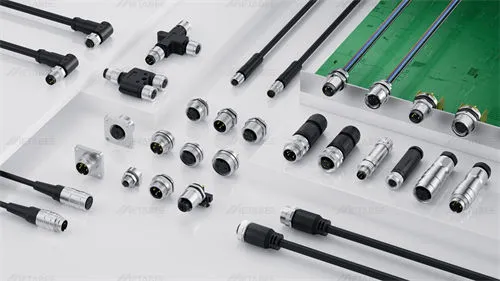
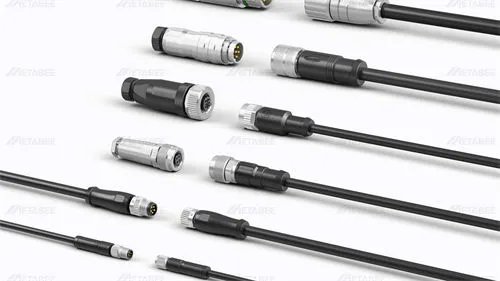
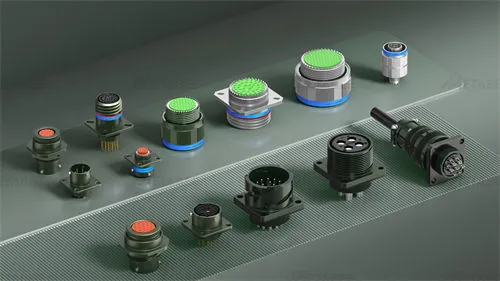
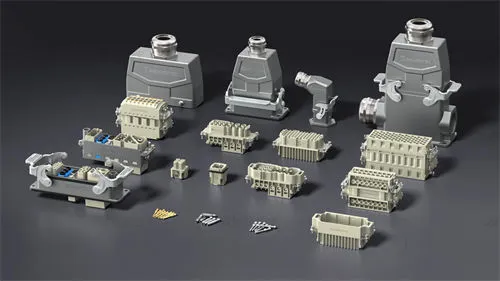
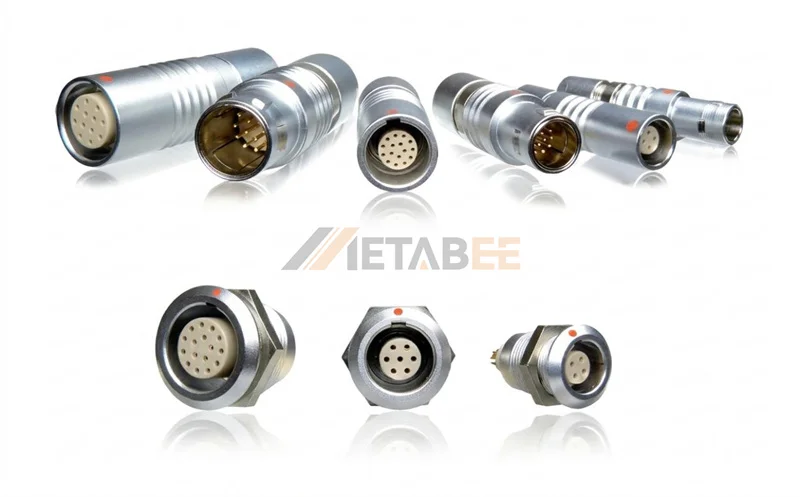
A push-pull connector uses an axial push-to-connect mechanism and a self-latching design to create a secure electrical connection. Unlike threaded connectors, it requires no rotation to mate or release, making it ideal for applications that demand quick connections, compact installation, and frequent mating cycles. These circular push-pull connectors are widely used in medical devices, industrial automation, test equipment, and professional audio/video systems.
LEMO connectors are well-known examples, but identifying an unknown model or finding a compatible alternative can be challenging. This guide explains how push-pull connectors work, compares LEMO B, K, S, and P series, and provides a practical method for identifying connector models and evaluating alternatives based on mechanical, electrical, and material specifications.
- What Is a Push-Pull Connector?
- How to Identify a LEMO Connector
- Decode the LEMO Part Number
- Comprehensive Comparison: LEMO B vs. K vs. S vs. P Series
- Application of Push-Pull Connectors
- Selection Guide: Matching the Right Connector
- Metabee Push-Pull Connector Alternatives for LEMO Applications
- Conclusion
- FAQs
What Is a Push-Pull Connector?
A push-pull connector is an electrical connector that uses a self-latching mechanism to secure the plug and receptacle. Users simply push the plug into the receptacle to establish a connection and pull back the release sleeve to disconnect it. Unlike threaded connectors, it requires no rotation, making it ideal for applications that require quick connections and frequent mating cycles.
LEMO is one of the best-known manufacturers of precision push-pull circular connectors. Its product portfolio includes the metal ORIGINALS series, such as B, K, and S, and the plastic REDEL series, including P connectors. These product families serve different requirements for environmental protection, contact density, and application conditions.
Other established manufacturers, including Fischer Connectors, ODU, Hirose, and Amphenol, also offer push-pull connector solutions. However, this guide focuses on LEMO connector identification, series comparison, and alternative selection.
How Does Self-Latching Work?
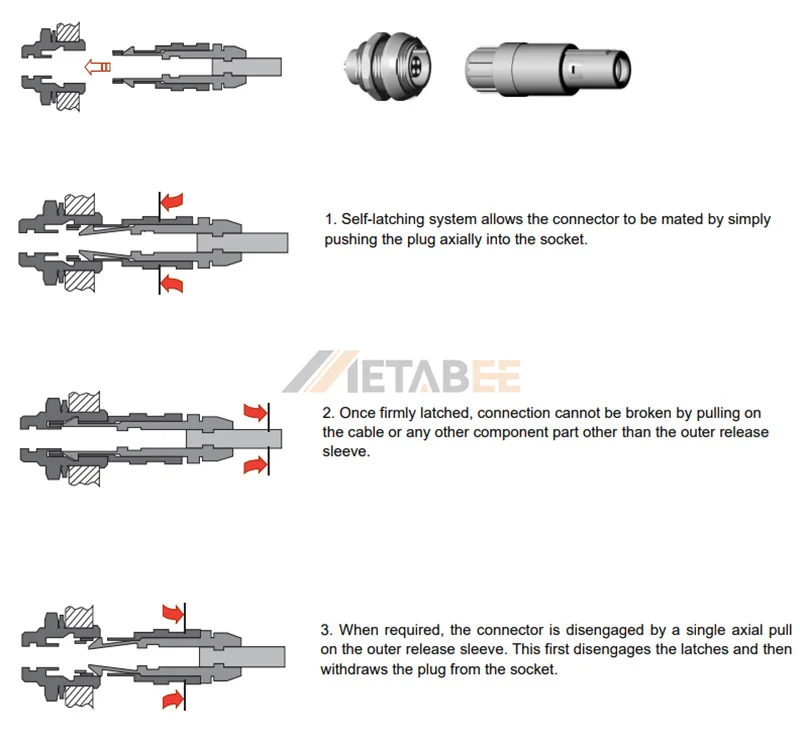
The self-latching mechanism uses internal locking elements to secure the plug inside the receptacle.
The connection process follows three steps:
- Mating: Align the plug with the receptacle and push it straight in along the connector axis.
- Latching: Internal locking elements engage the mating groove and secure the connection. A distinct click provides audible and tactile confirmation.
- Unmating: Pull back the outer release sleeve to disengage the locking elements, then withdraw the plug.
Key Advantages of Push-Pull Connectors
- Tool-free operation: Connect and disconnect without turning a coupling nut or using tools.
- Accidental disconnect prevention: The self-latching mechanism helps prevent unintended separation during normal operation.
- Blind mating: Compatible keyed or stepped interfaces help users connect plugs without directly viewing the contact arrangement.
- High mating-cycle capability: Many models support thousands of mating cycles, although the rated endurance varies by product.
The actual retention force, release force, and mating life depend on the connector design and manufacturer specifications.
Push-Pull vs. Threaded vs. Bayonet
Why do modern systems replace traditional screw-lock connectors with push-pull designs? Look at how the three primary locking mechanisms compare:
| Feature / Metric | Push-Pull Self-Latching | Threaded Coupling | Bayonet Coupling |
|---|---|---|---|
| Mating Speed | Very fast | Slower | Fast |
| Locking Mechanism | Internal self-latching mechanism | Threaded coupling nut | Locking pins and cam tracks |
| Release Method | Pull back the release sleeve | Unscrew the coupling nut | Reverse the locking rotation |
| Installation Clearance | Minimal radial clearance; finger access required | Requires space to rotate the coupling nut | Requires clearance for rotational movement |
| Panel Packing Density | Ultra-high (compact spacing) | Low (must fit fingers around nut) | Medium |
| Pull-Off Resistance | Secure latching; depends on release mechanism design | Secure when properly tightened; depends on thread retention | Secure pin engagement; depends on locking design |
| Blind-Mating Support | Excellent | Limited | Good |
Push-pull prioritizes speed, threaded coupling emphasizes secure engagement, and bayonet coupling balances connection speed with mechanical locking.
A threaded connector does not automatically provide better vibration resistance than every push-pull connector. Compare the actual retention and vibration specifications for the models under consideration.
How to Identify a LEMO Connector
Identifying a LEMO connector starts with its external markings and physical features. The shell marking, connector size, keying structure, and contact insert can help narrow down the exact model.
Shell Design & Brand Markings
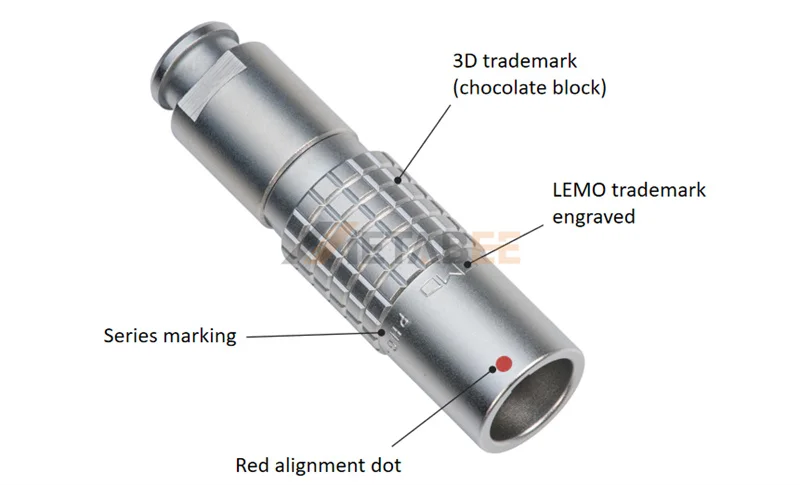
LEMO marks its connectors with a logo and model information. On plugs, the model, size, and series codes typically appear around the outer shell. Receptacles usually carry the LEMO trademark and the first five characters of the part number.
Look for these identifying features:
- 3D Knurling Pattern: The distinctive chocolate-block texture on the grip.
- LEMO Trademark: The engraved LEMO logo on the housing.
- Model Marking: The model code, such as FGG.1B.
- Red Alignment Dot: A visual reference for connector alignment.
Identify the Shell Size
The LEMO model marking provides the first clue to connector size. For example, FGG.1B identifies a straight plug in the B series, size 1B.
If the marking is unreadable, use a digital caliper to measure the outer diameter (ØA) of the plug’s mating shell.
LEMO B-Series Connectors in Different Shell Sizes
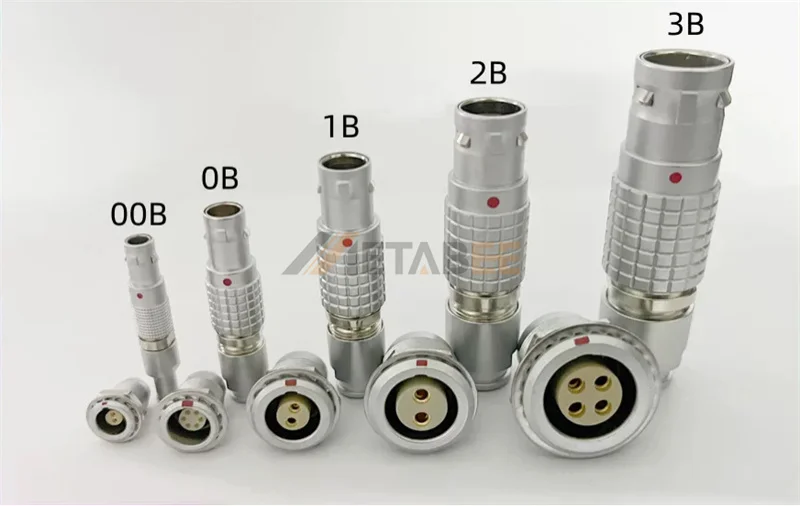
How to Measure:
- Measure the cylindrical mating shell, not the knurled grip.
- Avoid the cable collet, rear nut, and bend-relief accessory.
- Compare the measurement with the reference dimensions below.
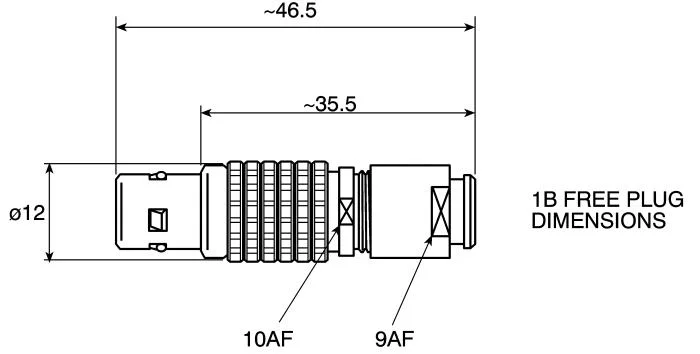
LEMO Plug Shell Size Reference
The following dimensions cover common straight-plug configurations. Use them as a preliminary identification reference.
| B Series | K Series | S Series | REDEL P Series |
| 00: 6.4 mm | 0K: 11 mm | 0S: 9 mm | 1P: 14 mm |
| 0B: 9.5 mm | 1K: 13 mm | 1S: 12 mm | 2P: 18 mm |
| 1B: 12 mm | 2K: 16 mm | 2S: 14.8 mm | 3P: 18.8 / 21.2 mm |
| 2B: 15 mm | 3K: 19 mm | 3S: 17.8 mm | — |
| 3B: 18 mm | 4K: 25 mm | 4S: 24.8 mm | — |
| 4B: 25 mm | 5K: 38 mm | 5S: 35 mm | — |
Reference dimensions are based on standard FGG straight plugs for B/K series and FFA straight plugs for S series. Actual dimensions may vary with plug design.
Determine the Keying Angle
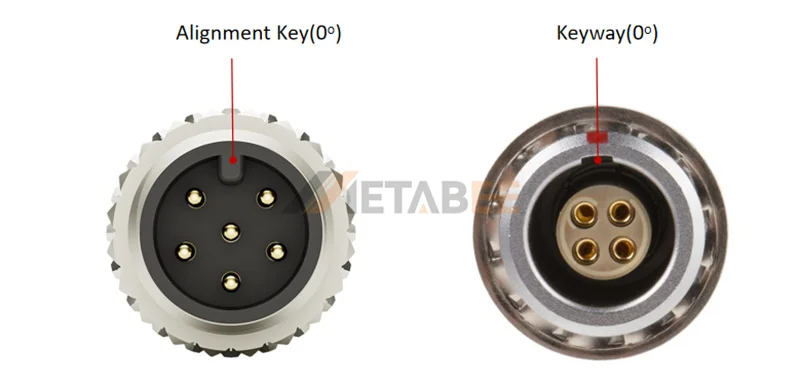
Keying controls the mating orientation of a circular connector. An alignment key on the plug fits into a matching keyway on the receptacle, guiding correct insertion and preventing mismating.
To identify the keying configuration:
- Locate the Alignment Key: Inspect the plug’s mating end and find the raised key. Check the receptacle for the matching keyway.
- Check the Key Position: Observe the number and angular positions of the keys.
- Read the Model Code: The third letter of the LEMO model code indicates the key style. For example, FGG.1B uses a G key, while FGA.1B uses an A key.
Common B-Series Keying Examples:
- G Key: One alignment key at 0°.
- A Key: Two alignment keys at 30°.
Other configurations are available. Always check the corresponding LEMO keying diagram, as key positions vary by series and shell size. For a complete reference, see the LEMO Official Keying Diagrams, which show key codes, the number of keys, and their angular positions for the B Series (page 36) and K Series (page 49).
Decode the LEMO Part Number
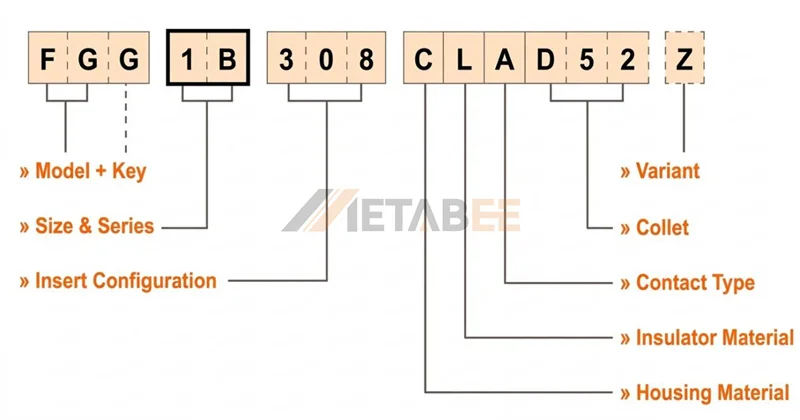
A LEMO part number combines several product details into a structured code. Once you identify its components, you can determine the connector’s model, series, contact configuration, materials, and cable termination. Break down this standard part number: FGG.1B.308.CLAD52Z
Using FGG.1B.308.CLAD52Z as an example:
- FGG – Model & Key: Straight plug with cable collet, G key.
- 1B – Size & Series: Size 1, B Series.
- 308 – Insert Configuration: Multipole insert with 8 contacts.
- C – Housing Material: Chrome-plated brass.
- L – Insulator Material: PEEK.
- A – Contact Type: Male solder contacts.
- D52 – Collet: B-Series collet with a 5.2 mm collet diameter.
- Z – Variant: Collet nut for fitting a bend relief on this free plug.
Common LEMO Model Codes
The first three characters of a LEMO part number identify the connector model and keying configuration. The first letter indicates the general connector type, while the third letter specifies the key style in mechanically keyed models.
Common examples include:
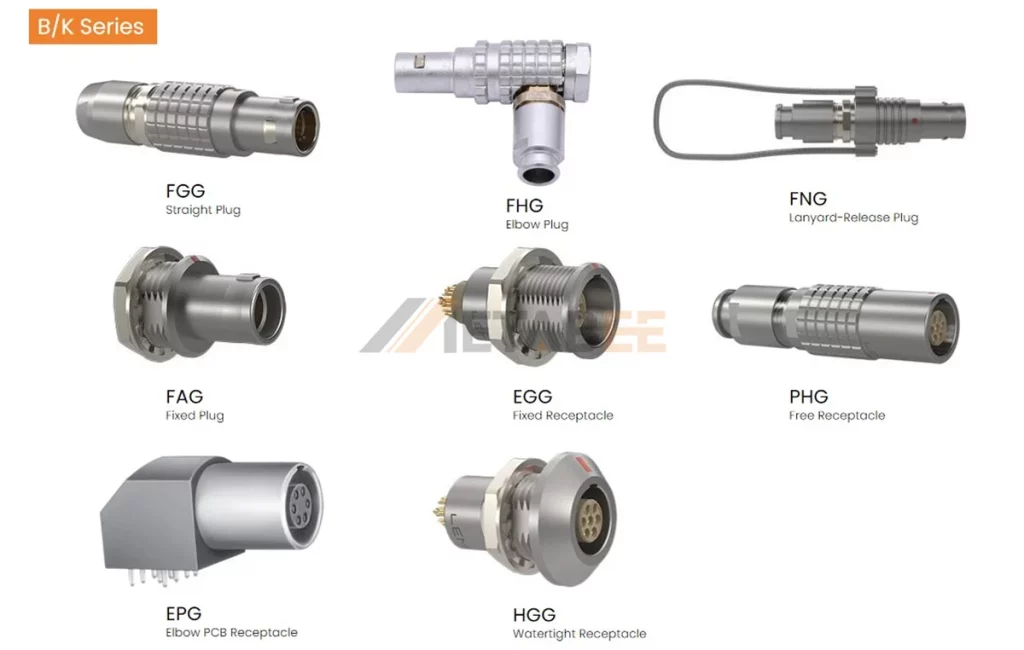
| Model Code | Connector Type | Series |
|---|---|---|
| FGG | Straight Plug | B / K |
| FHG | Elbow Plug | B |
| FNG | Lanyard-Release Plug | B |
| FAG | Fixed Plug | B |
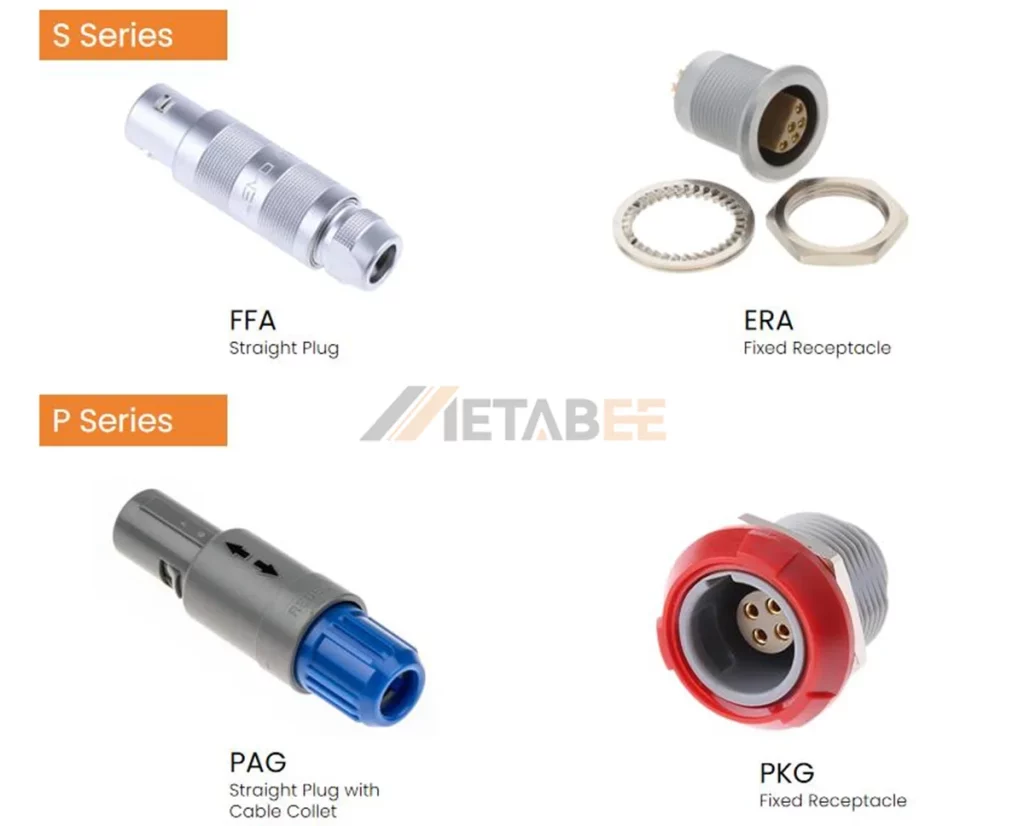
| FFA | Straight Plug | S |
| PAG | Straight Plug | P |
| EGG | Fixed Receptacle | B / K |
| PHG | Free Receptacle | B / K |
| EPG | Elbow PCB Receptacle | B |
| HGG | Watertight Receptacle | B |
| ERA | Fixed Receptacle | S |
| PKG | Fixed Receptacle | P |
Size & Series
- First character (X): Shell size.
- Second character (Y): Connector series.
Examples:
– 0B: Size 0, B Series
– 1B: Size 1, B Series
– 2B: Size 2, B Series
– 1K: Size 1, K Series
– 2S: Size 2, S Series
Insert Configuration
Position 6 – First Digit of the Insert Configuration
– 1: Unipole (single contact; commonly a low-voltage pin)
– 2: Coaxial
– 3: Multipole (multiple contacts; commonly low-voltage pins)
– 4: High Voltage
– 6: Triaxial
– 7: Hybrid Low Voltage + High Voltage
– 8: Hybrid Low Voltage + Coaxial
– 9: Other Hybrid Configurations
– 0: Fluidic
– X: Fiber Optic
For a complete list of available codes and their meanings, refer to the LEMO Part Numbers Explained – Official Guide.
Comprehensive Comparison: LEMO B vs. K vs. S vs. P Series
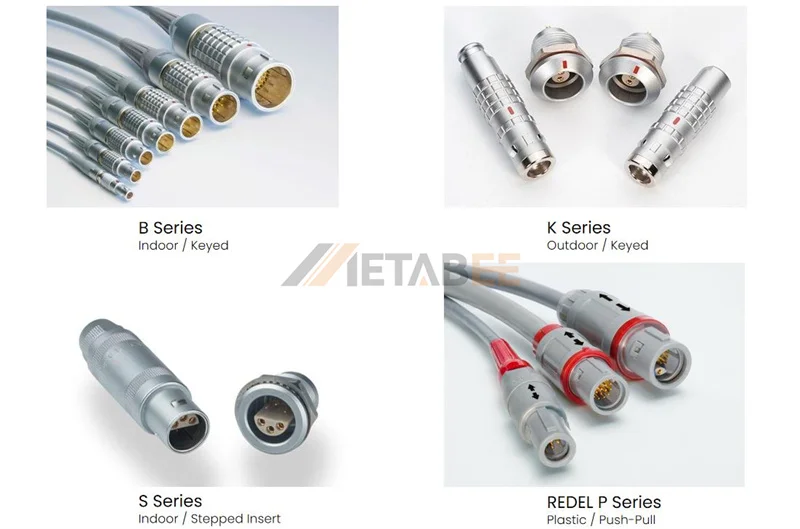
LEMO offers several push-pull connector families for different environmental and electrical requirements. The B, K, and S series belong to its metallic ORIGINALS range, while REDEL P provides a plastic push-pull solution.
Their main differences involve housing construction, environmental protection, insert design, and target applications.
Key Differences Between the Four Series
| Comparison | B Series | K Series | S Series | REDEL P Series |
| Housing Material | Metal | Metal | Metal | Plastic |
| Environment | Indoor / Protected | Outdoor / Exposed | Indoor / Protected | Indoor / Protected |
| Typical IP Rating | IP50 | IP68 when mated | IP50 | IP50 / IP64 versions |
| Max. Low-Voltage Contacts | 64 | 64 | 106 | 34 |
| Keying | Multiple key options | Multiple key options | Stepped half-moon insert | Mechanical keying and color coding |
| Main Feature | Compact, versatile contact layouts | Rugged environmental sealing | Blind-mating alignment | Lightweight, sterilizable construction |
| Typical Applications | Instrumentation, audio/video, laboratory equipment | Outdoor equipment, industrial systems | High-density instrumentation and blind-mating assemblies | Medical devices and patient-connected equipment |
Lemo B Series Connectors
The LEMO B Series is a metal push-pull connector range for indoor and protected environments (IP50).
Key features
- 8 shell sizes, with up to 64 contacts.
- Multiple keying options and high-density insert configurations.
- 360° EMC shielding.
Typical Applications: Test and measurement equipment, instrumentation, medical devices, and audio/video systems.
Lemo K Series Connectors
The LEMO K Series features a rugged metal housing and IP68 protection for outdoor and exposed environments.
Key features
- 6 shell sizes with multiple keying options.
- Compatible with B-series insert configurations.
- Enhanced environmental sealing and EMC shielding.
Typical Applications: Outdoor industrial equipment, transportation systems, and field measurement devices.
Lemo S Series Connectors
The LEMO S Series uses a stepped half-moon insert for accurate alignment and blind mating.
Key features
- 8 shell sizes, with up to 106 contacts.
- Stepped insert design for mechanical polarization.
- Compact metal construction for high-density connections.
Typical Applications: Precision instruments, electronic equipment, and blind-mating assemblies.
Lemo P Series Connectors
The REDEL P Series uses lightweight PEI or PSU housings for medical and other protected applications.
Key features
- Three connector sizes: 1P, 2P, and 3P.
- Multiple keying and color-coding options.
- Sterilizable construction, with IP50 and IP64 configurations.
Typical Applications: Medical instruments, surgical equipment, and patient monitoring devices.
Application of Push-Pull Connectors
Push-pull connectors power four core industries that demand fast, reliable links:

01 Medical Equipment
Patient monitoring and surgical instruments.

02 Broadcast & Video
Professional cameras and broadcast systems.

03 Test & Measurement
RF analyzers and precision test equipment.

04 Industrial Automation
Robotic arms and motion control systems.
Selection Guide: Matching the Right Connector
Selecting the right push-pull connector starts with your application requirements. Focus on three key factors to narrow down the options.
Step 1: Choose the Right Series
Start with the operating environment and application. Use the four LEMO series as a reference:
- B Series: General-purpose indoor applications.
- K Series: Outdoor environments requiring IP68 protection when mated.
- S Series: High-density connections and blind-mating applications.
- REDEL P Series: Lightweight plastic connectors for medical applications.
Step 2: Match the Electrical and Mechanical Configuration
Once you identify the suitable series, confirm the connector configuration:
- Contact Configuration: Number and type of contacts, rated voltage and current.
- Shell Size: Connector dimensions and available installation space.
- Keying: Compatible plug and receptacle alignment.
Step 3: Check Cable Compatibility and Performance
Finally, make sure the connector fits your cable and operating requirements.
- Cable Compatibility: Match cable OD and termination type (solder, crimp, or PCB).
- Performance: Check IP rating, operating temperature, mating cycles, and EMI shielding requirements.
Before ordering, verify the complete plug-and-receptacle combination against the manufacturer’s dimensional drawing and datasheet.
Metabee Push-Pull Connector Alternatives for LEMO Applications
Metabee offers push-pull connector alternatives for applications that use LEMO connectors. Its product range includes metal MB-B, MB-K, and MB-S series, as well as plastic MB-P connectors. These options cover different shell sizes, contact configurations, keying arrangements, and mounting styles.
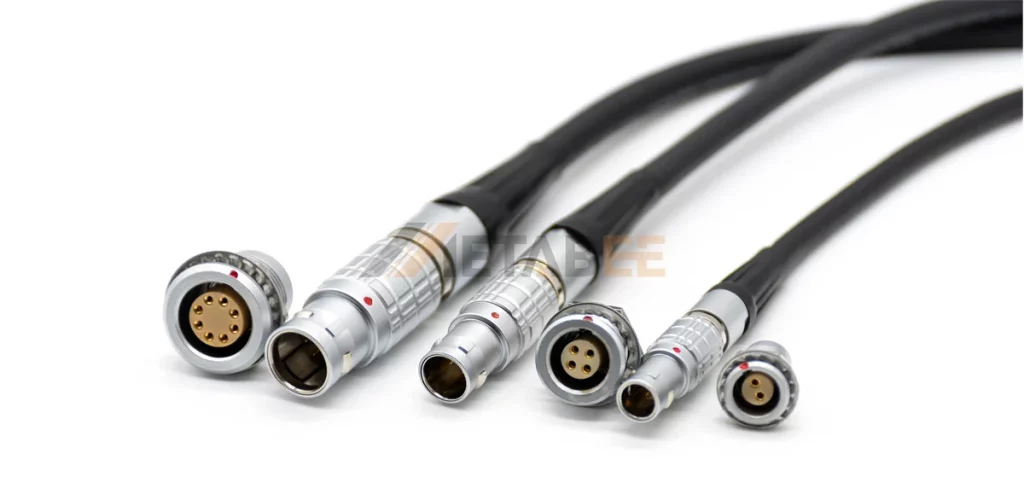
Metabee provides several connector configurations to meet different application requirements:
- MB-B Series: Metal push-pull connectors with multiple shell sizes and contact configurations.
- MB-K Series: Waterproof metal connectors for demanding environments.
- MB-S Series: Half-moon insert connectors for high-density connections.
- MB-P Series: Lightweight plastic connectors for specialized applications.
Explore the Metabee Push-Pull Connector Catalog for product configurations and specifications.
Compatibility & Performance
When evaluating a Metabee alternative, compare the following specifications with the original LEMO connector:
- Mechanical Interface: Shell dimensions, keying positions, and mating geometry.
- Electrical Configuration: Contact arrangement, termination type, voltage, and current ratings.
- Environmental Performance: IP rating, operating temperature, vibration resistance, and mating cycles.
Matching shell size and contact count alone does not guarantee direct mating compatibility. Verify the complete interface and test samples before replacement.
Customization & Supply Support
Metabee also supports OEM/ODM manufacturing and customized cable assemblies.
- Customized contact configurations and termination styles.
- Different housing materials and connector finishes.
- Custom cable lengths and assembly configurations.
- Flexible production and supply support.
Looking for a LEMO Connector Alternative?
Send us your original part number, drawing, or sample. Contact our engineering team to discuss compatible connector and cable assembly solutions.
Conclusion
Push-pull connectors offer a practical solution for applications that require fast mating, secure retention, and compact installation.
Understanding the self-latching mechanism, identifying LEMO series, and comparing connector specifications can help engineers select the right interface and evaluate alternative products.
Whether you need a B-series replacement, a waterproof K-series alternative, or a customized push-pull cable assembly, always verify mechanical, electrical, and environmental compatibility before making a selection. Metabee provides alternative push-pull connectors and customized cable assembly solutions. Discuss Your LEMO Replacement Requirements to find a suitable replacement for your project.
FAQs
Q1. What is the difference between a push-pull and a self-latching connector?
A: Push-pull describes the mating and release operation, while self-latching describes the locking mechanism. Most push-pull connectors use an internal self-latching mechanism to secure the plug.
Q2. Are LEMO connectors interchangeable between different series?
A: No. B, K, S, and REDEL P connectors use different mechanical interfaces and insert designs. Similar contact counts or shell-size numbers do not guarantee compatibility.
Q3. How do I identify an unknown LEMO connector?
A: Check the LEMO logo, model markings, series code, shell dimensions, keying arrangement, and contact configuration. Then compare these details with the manufacturer’s catalog and part-number guide.
Q4. Are push-pull connectors suitable for outdoor applications?
A: Yes. Certain models, such as the LEMO K series, provide IP68 protection in specified mated configurations. Other push-pull connectors may only suit indoor or protected environments. Always verify the model’s IP rating.
Q5. Can I replace an original LEMO connector with a compatible alternative?
A:Yes, provided the alternative meets the required mechanical, electrical, and environmental specifications. Verify the mating interface, keying, contact arrangement, cable termination, and performance through testing before production use.
