
In modern RF and automotive communication systems, the demand for reliable, high-frequency signal transmission has never been higher. Among various RF connector solutions, Fakra connectors have become the de facto standard for automotive-grade high-frequency applications due to their robustness, standardized design, and error-proof connection system.
This comprehensive guide will delve into the world of Fakra connectors, providing a detailed understanding of their definition, specifications, types, and diverse applications. Whether you’re an engineer, a purchasing agent, or simply curious about the technology underpinning modern connectivity, this article will equip you with the knowledge to appreciate and choose the right Fakra connector for your needs.
What is a Fakra Connector
Definition
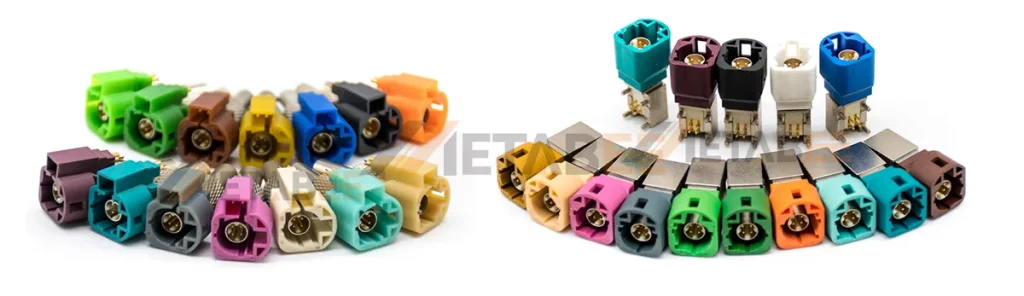
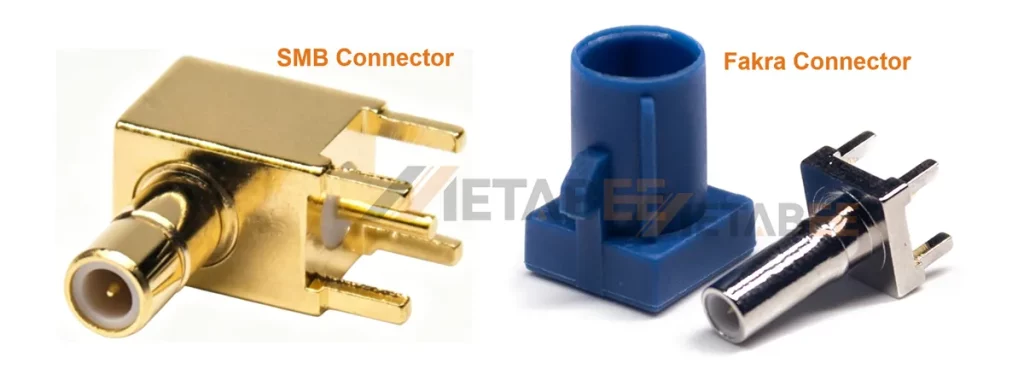
A Fakra connector is a standardized coaxial connector primarily used in the automotive industry for high-frequency applications. It is based on the SMB (Sub-Miniature B) connector interface but features a plastic housing with a locking mechanism and a keying color-coding system. The designs are to meet the rigorous demands of vehicular environments. Consequently, they are widely employed to transmit high-frequency signals, providing robust and vibration-resistant connections for a diverse range of radio frequency (RF) signals.
The term “FAKRA” is an abbreviation of the German phrase Fachkreis Automobil (Automobile Working Group). Originally, it was developed by a committee of German automobile manufacturers who sought a universal, high-performance interface for radio frequency signals. In particular, the purpose was to replace diverse, non-standardized connectors with a single system that provided mechanical security and prevented assembly errors through color coding.
Standard
The Fakra connector complies with several automotive and RF standards, including:
These standardizations ensure interoperability, durability, and performance consistency across different manufacturers and automotive platforms. As a result, Fakra has become a globally recognized solution for automotive RF connections.
I hope this split and the added transition word enhance clarity!
Key Features
Fakra connectors offer a set of distinct advantages and specialized design features that make them ideal for the rigorous demands of the automotive industry:
- High-Performance Frequency Range: These connectors are capable of operating at frequencies up to 6 GHz. Consequently, they ensure high-speed data integrity across a wide array of wireless technologies and RF applications.
- Keying & Color-Coding System: A dual-safety system featuring unique mechanical “keying” and distinct colors for each application. This combination prevents the accidental mating of incompatible components and simplifies complex assembly processes.
- Dual Locking Mechanisms: Beyond the primary audible “click” lock, many versions include secondary locking features. Ultimately, this ensures a secure connection that resists extreme vehicle vibrations and accidental disconnection in dynamic automotive settings.
- Robust Environmental Protection: The specialized plastic housing protects the internal RF core against environmental factors, high mechanical stress, and extreme temperature fluctuations (-40℃ to +105℃).
- Precision Impedance Matching: They maintain a standardized 50 Ohm impedance. This is crucial as it optimizes for common RF circuits to minimize signal reflection and transmission loss.
- Exceptional Mechanical Durability: Designed for longevity, these connectors are built to withstand the physical rigors of a vehicle’s life-cycle while maintaining consistent electrical performance.
Why Fakra Connectors Matter in Modern RF Systems
Several critical factors define the importance of Fakra connectors in modern RF systems.
- Signal Integrity in Harsh Environments: High-speed data transmission is highly sensitive to interference. Fakra connectors provide superior shielding to protect critical safety and entertainment data from electromagnetic interference (EMI).
- Prevention of Human Error: In complex modern wiring harnesses, multiple RF lines often run side-by-side. The color-coded keying system ensures that technicians cannot physically plug a critical safety sensor into a secondary entertainment port.
- Vibration and Impact Resistance: Standard RF connectors might loosen over thousands of miles of driving. The Fakra’s locking mechanism ensures that connections remain intact despite constant road vibration and mechanical shocks.
- Support for Next-Gen Telematics: From 5G connectivity to V2X (vehicle-to-everything) communication, Fakra connectors provide the stable frequency platform required for the high-bandwidth data exchange of autonomous driving features.
- Global Interoperability: Because Fakra is a standardized interface, it allows global supply chain flexibility, enabling manufacturers to source compatible antennas and modules from various worldwide suppliers.
Structure and Design
Key Components
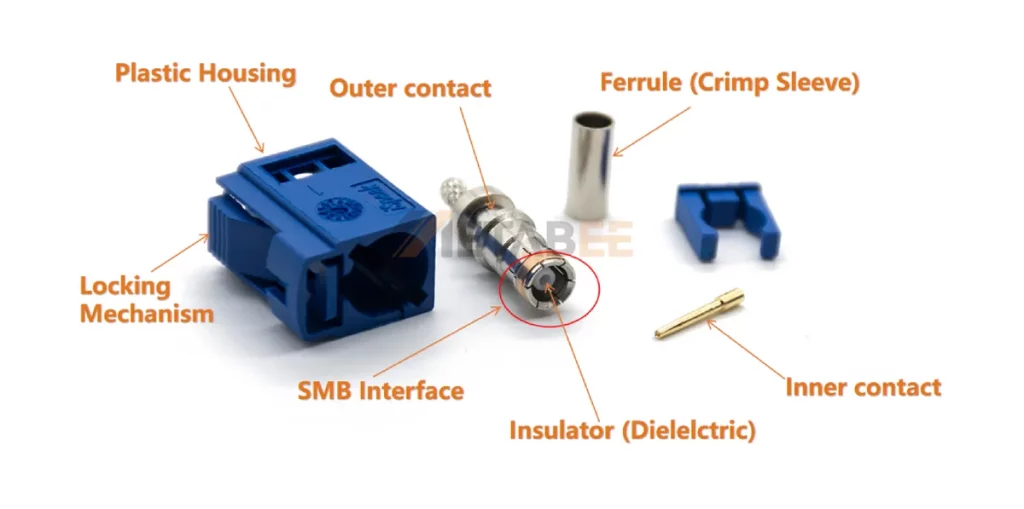
A standard Fakra connector comprises several essential components:
- SMB Interface: The internal electrical interface is based on the SMB coaxial connector, known for its snap-on coupling and good electrical performance.
- Plastic Housing (Coded and Keyed): The most distinctive part, the outer shell, is made of high-performance plastic, provides mechanical protection, and incorporates the color and keying features.
- Inner Contact: Transmits the RF signal. Usually made of gold-plated brass for optimal conductivity.
- Outer Contact: Provides the ground connection and shields the signal.
- Insulator(Dielectric): PTFE (Teflon) to maintain impedance.
- Ferrule: Secures the cable to the connector body, providing strain relief and maintaining shield integrity.
- Locking Mechanism: Integrated into the plastic housing, it ensures a secure, positive lock when mated.
Component and material, plating of Fakra connectors:
| Component | Material | Plating |
| Plastic Housing | PA | – |
| Inner Contact | Copper Alloy | Gold Plating |
| Outer Contact | Zinc Alloy | Nickel Plating |
| Insulator | PTFE or PBT | – |
Fakra Connector Color Codes
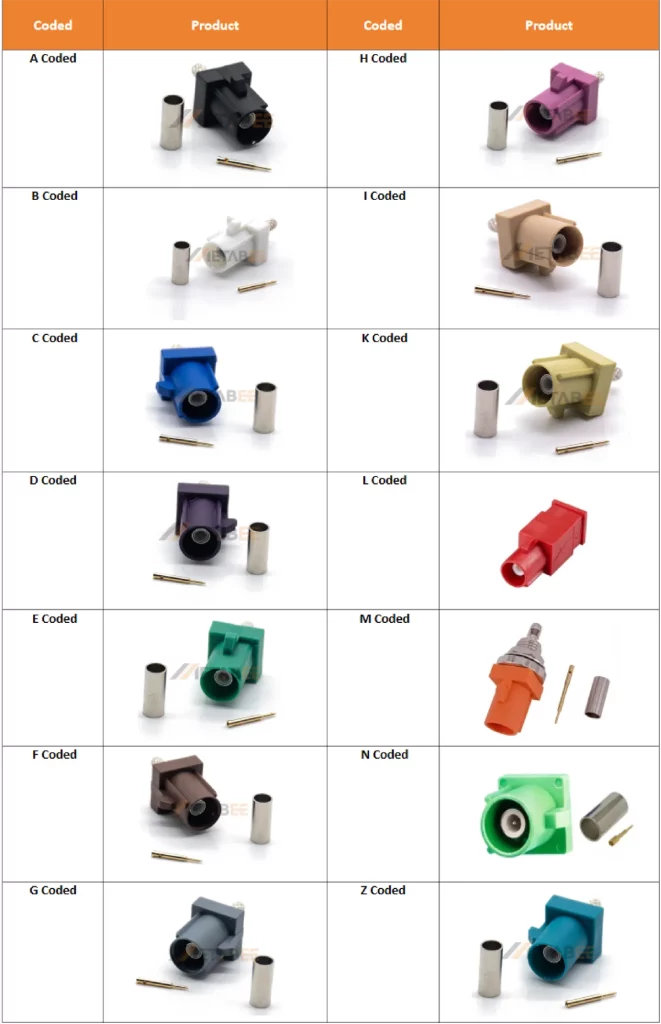
To simplify assembly and prevent errors in complex wiring looms, Fakra connectors use a standardized color-coding system (A–Z coded). What’s more, each color corresponds to a specific application and mechanical keying.
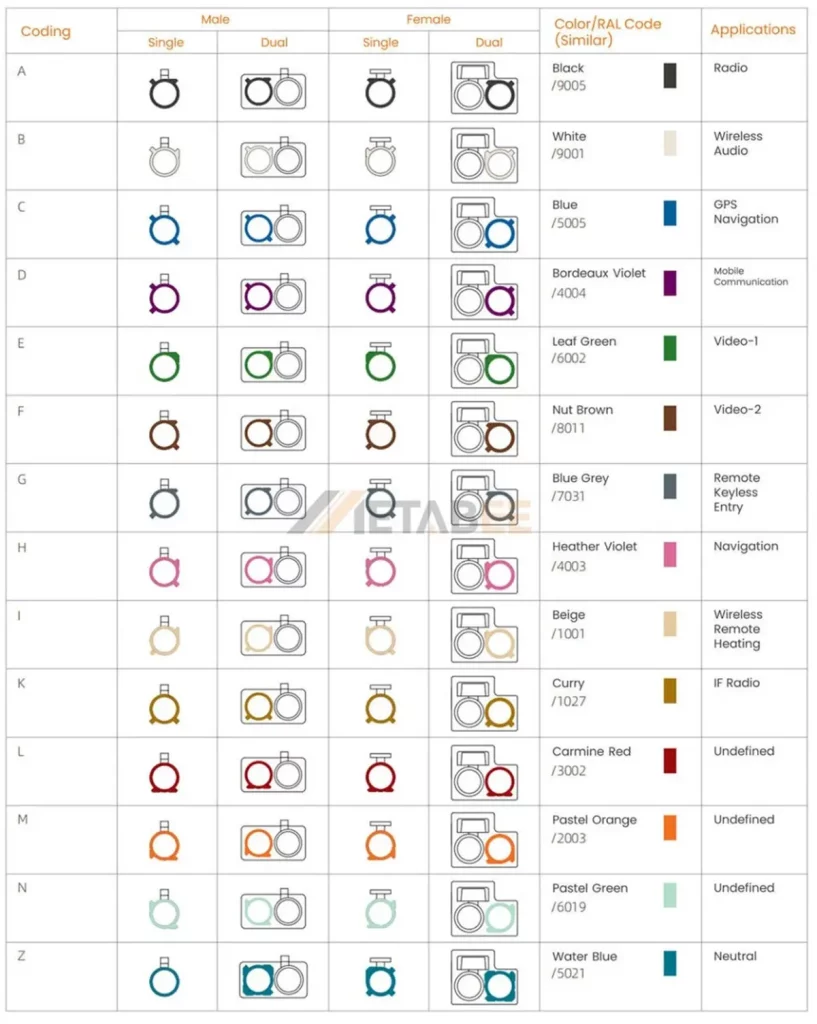
Note: The “Z” code is often used for unkeyed or custom applications, allowing for greater flexibility.
Locking Mechanism
The locking system is arguably the most critical structural feature of a Fakra connector, distinguishing it from general-purpose RF interfaces. More importantly, it is critical for maintaining signal integrity in automotive environments. Indeed, it ensures the connection remains stable against vibration and mechanical shocks through two main stages:
- Primary Lock: An integrated spring-loaded latch that provides an audible “click” upon successful mating, confirming the connector is fully seated.
- Secondary Lock (TPA): An optional but common plastic clip used in mission-critical systems (like ADAS). It ensures the primary latch cannot release accidentally under extreme tension.
Benefits:
- Vibration Resistance: Prevents signal “noise” or disconnects on rough roads.
- High Retention: Offers significantly higher pull-out force than standard SMB connectors.
- Precision Fit: Tight tolerances eliminate internal movement and physical wear.
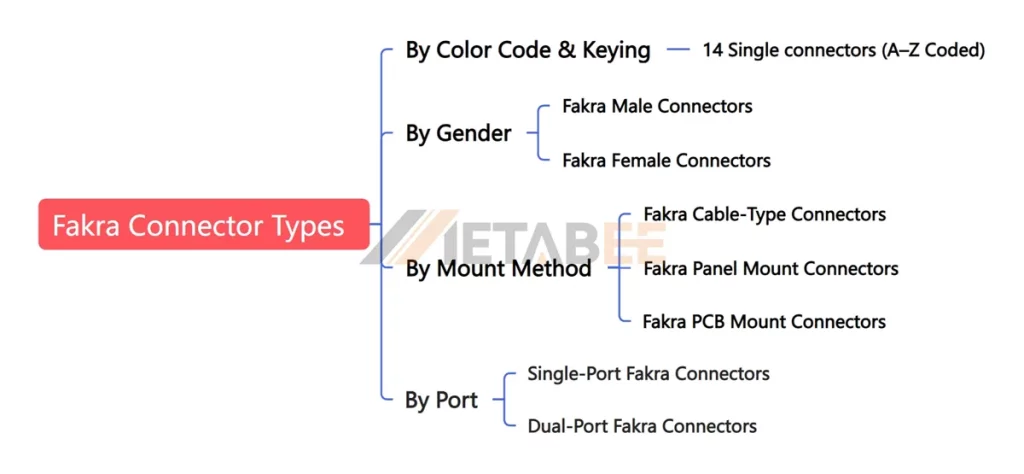
Fakra Connector Types
Fakra connectors are categorized in several ways, reflecting their versatility and adaptation to various specific needs.
By Color Code & Keying
There are 14 standardized mechanical keys (A through N), each with its own color. Thus, this physical barrier prevents a GPS antenna from being accidentally plugged into a radio port.
By Gender
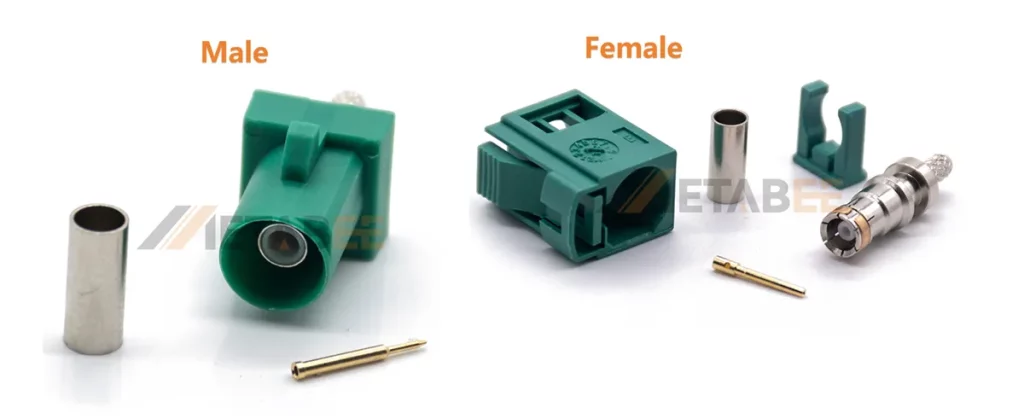
Like most electrical connectors, Fakra connectors come in two genders:
- Male (Plug): available on the device (PCB-mount) or as a cable end. Features a center pin and the outer keying ribs.
- Female (Jack): Usually the cable-side connector. Features a center socket and the locking clip.
By Mount Method
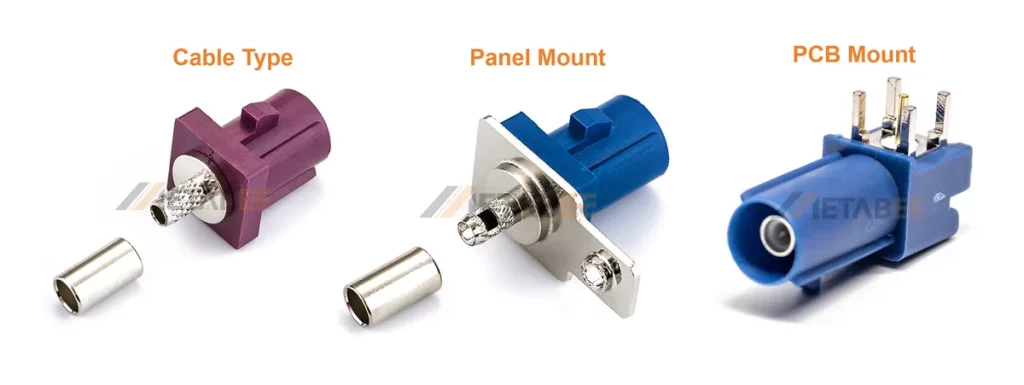
RF Fakra connectors can be mounted in various ways depending on the application:
- Cable Type: These connectors are terminated directly onto coaxial cables. They can be crimp, solder, or clamp types, chosen based on cable type and application requirements.
- Panel Mount: These connectors are designed to be securely fastened to a panel or chassis, often featuring a threaded body or snap-in mechanism.
- PCB Mount: Designed to be soldered onto printed circuit boards. They are available in straight or right-angle configurations and can be through-hole or surface-mount types.
By Ports: Single vs. Dual Fakra
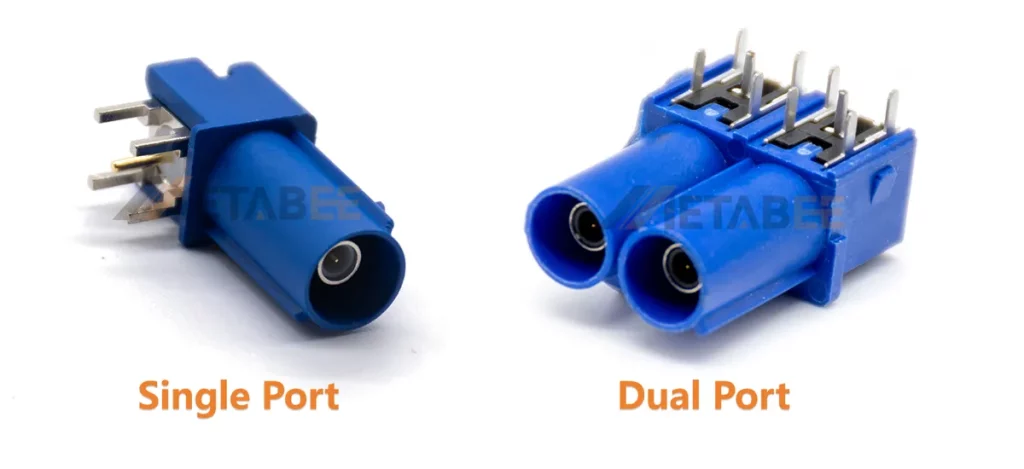
While single Fakra connectors are standard, dual Fakra configurations are also available.
- Single Port: The most common type, providing one RF channel per connector.
- Dual Port: Integrates two Fakra connectors into a single housing, often side-by-side. This design is particularly useful for applications requiring two adjacent RF connections.
Technical Specifications
Fakra connectors adhere to stringent technical specifications to ensure optimal performance:
| Parameter | Specification |
| Impedance | 50 Ohm |
| Frequency Range | DC to 6 GHz |
| VSWR | ≤1.3 |
| Insertion Loss | ≤0.3dB |
| Operating Temperature | -40°C to +105°C |
| Mating Cycles | ≥100 Cycles |
Fakra Connector Applications
Fakra connectors are integral to a wide array of applications, primarily driven by the automotive sector but extending into other fields requiring robust RF connectivity.
Automotive Systems
The automotive industry is the primary domain for Fakra connectors. Their robust design, high-frequency capability, and standardized approach make them ideal for:
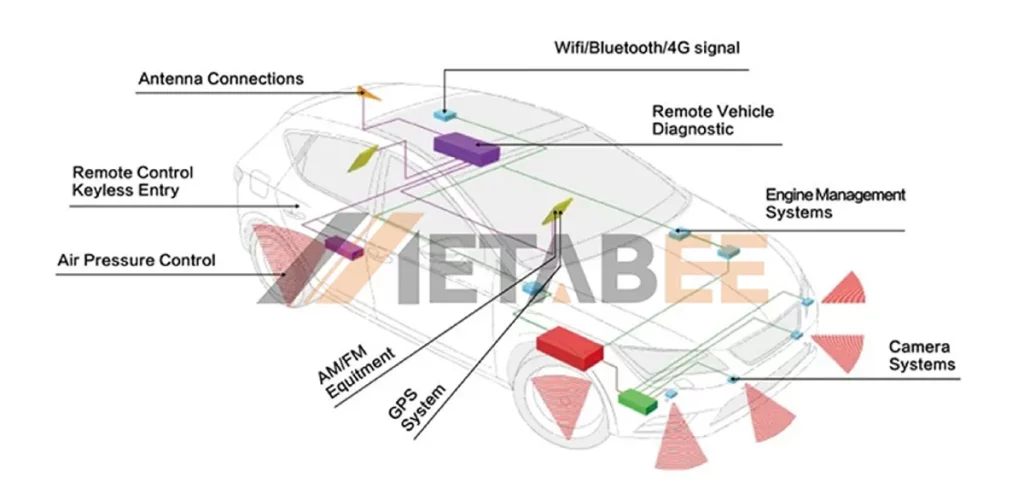
- Infotainment Systems: Linking AM/FM, DAB (Digital Audio Broadcasting), and satellite radio antennas, as well as connections for display units and other multimedia components.
- Telematics: Providing connections for cellular communication (2G/3G/4G/5G), eCall systems, and remote vehicle diagnostics.
- ADAS (Advanced Driver-Assistance Systems): Used for connections to radar sensors, reverse cameras (e.g., surround view and rear-view cameras), and other sensors that rely on RF signals for collision avoidance and autonomous driving features.
- Keyless Entry Systems: Transmitting signals for remote key fobs and passive entry systems.
- Wi-Fi and Bluetooth: Onboard connectivity for hotspots and device pairing.
Telecommunications
While primarily automotive, Fakra connectors can also find uses in telecommunications, particularly in specialized niche applications requiring compact and robust RF interconnects for:
- Base Stations (Small Cells): In certain compact base station designs, where space is limited and environmental robustness is key.
- Wireless Infrastructure: For internal connections within specialized wireless communication modules.
IoT Devices
The growing Internet of Things (IoT) market also presents opportunities for Fakra connectors, especially for devices deployed in harsh or mobile environments:
- Industrial IoT: Connecting sensors and communication modules in industrial settings where vibration and environmental factors are a concern.
- Fleet Management Devices: For GPS and cellular connections in tracking and telematics units for commercial vehicles.
- Smart Agriculture: In sensors and communication hubs deployed outdoors, requiring durable and weather-resistant connections.
SMB vs Fakra vs HSD
Understanding the differences between Fakra and other common automotive or RF connectors is crucial for proper selection.
Fakra vs SMB
The relationship between Fakra and SMB is fundamental:
- SMB: A general-purpose coaxial connector with a snap-on coupling mechanism, commonly used for RF applications up to 4 GHz. SMB connectors provide good electrical performance but lack environmental protection and specific keying for automotive applications.
- Fakra: The internal RF interface of a Fakra is an SMB. It encapsulates the SMB connector within a specially designed plastic housing. This housing adds the crucial features for automotive use:
- Environmental Protection: The plastic body provides enhanced protection against moisture, dust, and mechanical damage.
- Color-Coding & Keying: Prevents mis-mating.
- Locking Mechanism: Ensures a secure and vibration-resistant connection.
Fakra vs HSD
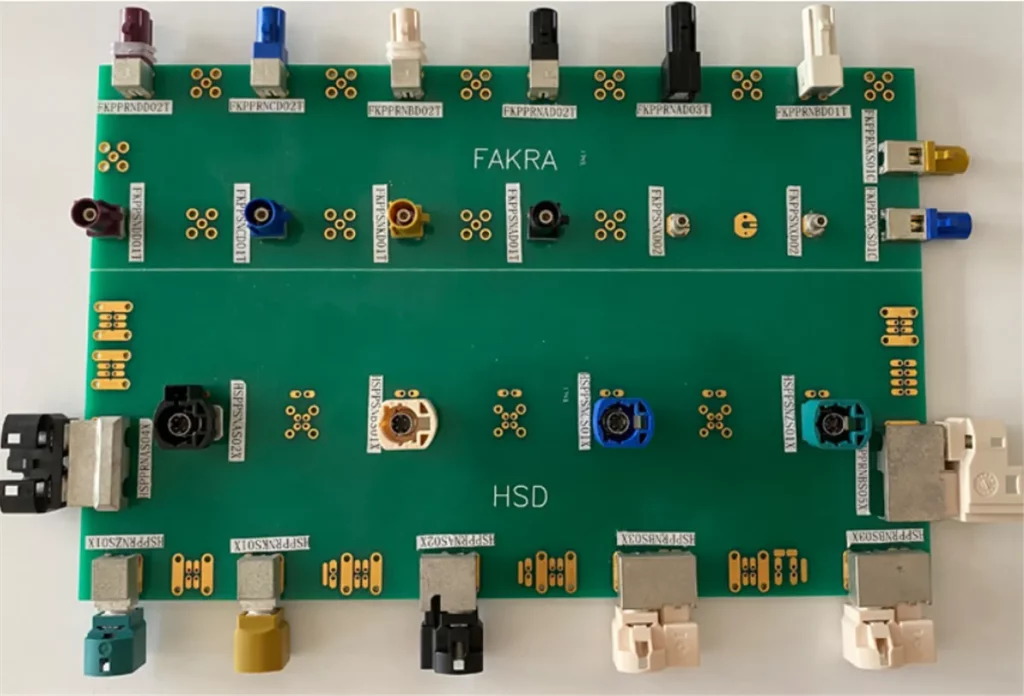
- HSD (High-Speed Data) connectors are another critical type of automotive connector, but they serve a different purpose than Fakra.
- HSD is a quad-axial system (comprising four wires) that actively transmits differential, high-speed digital data, including Ethernet, USB, and LVDS for displays. To achieve this, it employs shielded twisted quad cables or similar differential signal wiring.
- While Fakra is a coaxial connector for single-ended, high-frequency RF signals (GPS, radio, and cellular). It uses single-wire coaxial cables.
Key differences:
| Feature | Fakra | HSD |
| Purpose | RF signal transmission | High-speed digital data transmission |
| Signal Type | Single-ended (coaxial) | High-speed differential(shielded twisted quad) |
| Impedance | 50 Ohm | 100 Ohm |
| Use Case | GPS, RF signals | Data (USB, Ethernet, video) |
| Bandwidth | Up to 6 GHz | Higher data rates |
| Frequency/Speed | Up to 6 GHz (RF) | Up to several Gbps (digital data) |
| Applications | GPS, radio, cellular, camera video (analog) | Ethernet, USB, Display-Port, LVDS, camera video (digital) |
| Physical Design | Coaxial interface with plastic housing | Multi-pin interface with plastic housing |
Tips: they are not interchangeable.
How to Choose the Right Fakra Connector
Follow these five essential steps to ensure signal stability, installation compatibility, and system durability when selecting a Fakra connector:
Step 1: Confirm Function and Color Code
This is the most fundamental part of the selection process. The Fakra standard defines different color codes corresponding to specific mechanical keying patterns.
- Universal Option: If you are in the R&D stage or unsure of the required keying, use Code Z (Water Blue). Code Z is a universal code that can mate with any mechanical key from A to N.
Step 2: Select Mounting and Spatial Layout
Choose the physical interface form based on your device design:
- PCB Side: Choose between Straight or Right-Angle headers for soldering onto circuit boards.
- Cable Side: Used for wire harness connections; ensure the connector series matches the target cable size.
- Panel Mount: If the connector needs to be fixed to a chassis or dashboard panel, choose a version with a nut or clip.
Step 3: Verify Cable Compatibility
Not all Fakra connectors fit every cable. Common compatible cables include:
- Micro/Thin types: RG174, RG316 (ideal for short-distance connections with limited space).
- Low-Loss types: RTK031, RG58 (used for longer antenna feeds to minimize signal attenuation).
- Verify Dimensions: Ensure the inner diameter of the crimp ferrule matches the cable’s outer diameter.
Step 4: Evaluate Environmental Protection Level
- Interior Use: Standard Fakra connectors are usually sufficient.
- Exterior Use: For equipment exposed to the elements, such as shark-fin antennas or backup cameras, you must select connectors with an IP67 or IP69K rating. These typically feature additional O-ring seals.
Step 5: Validate Technical Parameters
- Frequency Requirements: While standard applications are below 4 GHz, 5G or V2X applications may require connectors supported up to 6 GHz.
- Durability: Check the mating cycles; industrial grades typically require more than 100 cycles.
Evolution: Mini-Fakra (HFM) – High-Speed Data
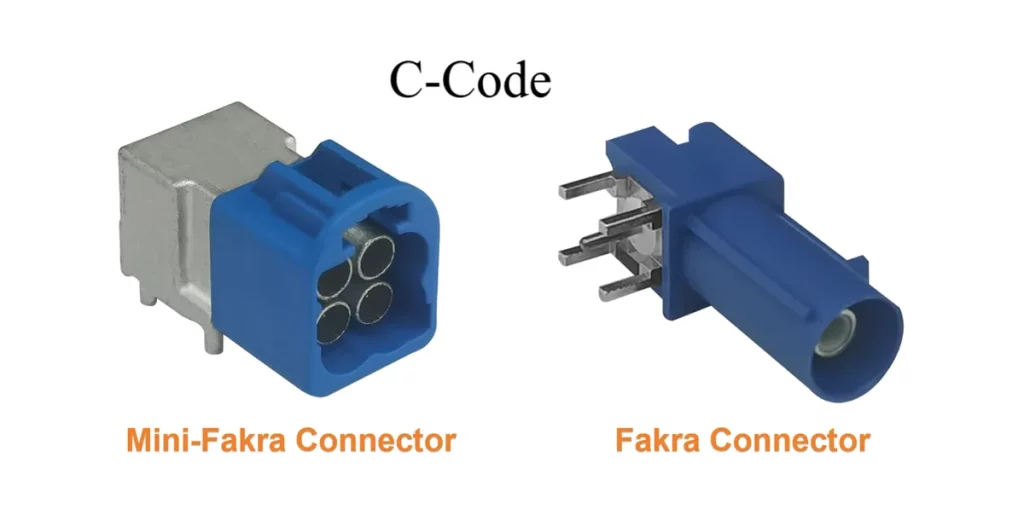
As vehicles transition toward autonomous driving and highly integrated “smart cockpits,” the data requirements have far exceeded the capacity of traditional Fakra connectors. This has led to the development of Mini-Fakra, also known as HFM (High-Speed FAKRA-Mini).
Why the Switch to Mini-Fakra?
- Unprecedented Bandwidth: While standard Fakra is optimized for up to 6 GHz, Mini-Fakra supports high-speed data rates up to 20 Gbps and frequencies reaching 15 GHz. This is essential for 4K sensor data and high-resolution real-time video streams.
- Extreme Space Efficiency: Mini-Fakra offers up to 80% space savings compared to standard Fakra connectors. This allows manufacturers to pack more RF ports onto a smaller PCB footprint, a critical requirement for compact domain controllers.
- Weight Reduction: The reduced size and modular design significantly lower the overall weight of the wiring harness, contributing to better fuel efficiency and EV range.
Key Performance Advantages
- Modular Design: Mini-Fakra housings can be stacked into 2-port, 4-port, or even larger blocks, simplifying the assembly of complex telematics units.
- Robust Automotive Grade: Despite its smaller size, it retains the critical mechanical locking and color-coded keying of the original Fakra standard, ensuring it withstands automotive vibrations and temperature cycles.
- Lower Latency: Optimized for high-frequency performance, HFM minimizes signal delay and reflection, which is vital for time-sensitive ADAS safety functions.
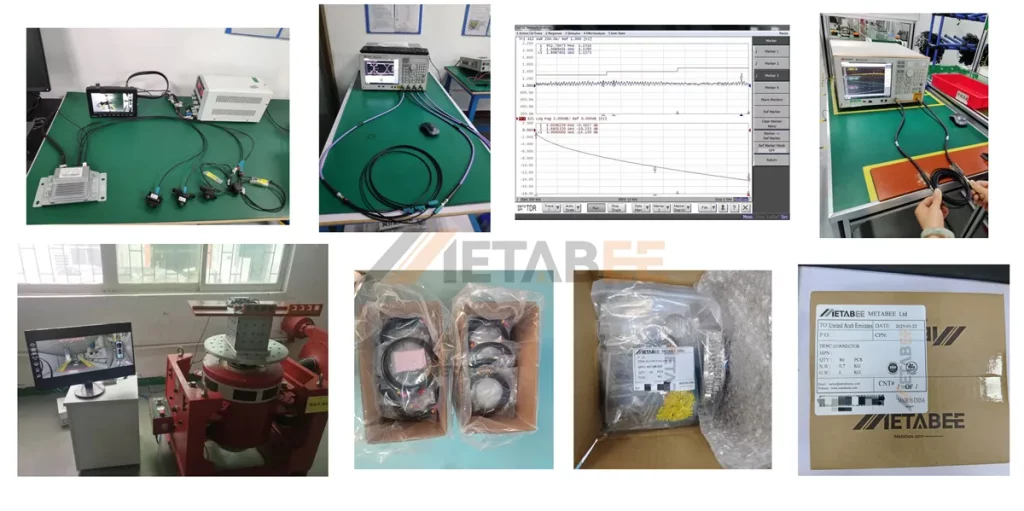
Why choose the Fakra connectors from Metabee?
Metabee is a leading global manufacturer specializing in high-performance RF connectors and cable assemblies. What’s more, with years of expertise in the automotive and telecommunications industries, we are committed to delivering precision-engineered connectivity solutions.
- Extensive Product Range: From standard Fakra and HSD to next-gen Mini-Fakra (HFM), we provide a comprehensive portfolio of automotive-grade connectors.
- Quality Assurance: All Metabee products are manufactured to meet international standards (ISO/USCAR), ensuring maximum reliability in mission-critical applications.
- Direct Factory Supply: We operate our own advanced manufacturing facilities, ensuring full control over production lead times and providing factory-direct wholesale pricing.
- Custom Solutions: Our engineering team provides end-to-end support, from R&D to final production, offering tailored cable assembly services to meet your specific technical requirements.
- Rapid Response: We pride ourselves on a customer-centric approach, offering technical support and fast logistics to keep your projects on track.
Conclusion
In summary, Fakra connectors are an indispensable technology underpinning the advanced electronic systems in modern vehicles and beyond. By seamlessly integrating the high-performance SMB core with a secure, color-coded mechanical housing, it addresses the most critical challenges of modern vehicle design: reliability, safety, and ease of assembly. Their standardized structure, color-coded system, and strong environmental resistance make them indispensable in applications ranging from GPS and telematics to advanced driver assistance systems.
As vehicles evolve toward Level 3+ autonomous driving and software-defined architectures, both standard Fakra and mini-Fakra (HFM) will continue to play a vital role in enabling the high-speed, fail-safe communication networks of the future. By understanding their various types, specifications, and applications, engineers and product developers can make informed decisions to select the perfect Fakra connector, ensuring optimal performance and reliability for their next-generation designs.
Have a specific requirement or project in mind? Our experts are ready to assist you with technical consulting and custom solutions.
Contact us today for a free consultation or a fast quote! We provide competitive pricing and rapid turnaround times for all your Fakra connector needs.
Related Products
- Fakra Connectors
- Fakra Male Connectors
- Fakra Female Connectors
- Mini Fakra Connectors
- HSD Connectors
- SMB Connectors
- Fakra Cable Assemblies
- HSD Cables
FAQs
Q1: Are Fakra connectors compatible with standard SMB connectors?
A: No—a standard SMB connector cannot be used as a direct replacement for a Fakra connector. Physically, the internal RF cores of Fakra are based on the SMB interface. However, the external plastic housing of a Fakra connector prevents it from mating with a standard SMB connector.
Q2: What is the maximum frequency a Fakra connector can handle?
A: Standard Fakra connectors are typically rated for frequencies up to 6 GHz, making them suitable for most common automotive RF applications.
Q3: Are all Fakra connectors compatible with each other?
A: No. While they share a common SMB electrical interface, Fakra connectors use a color-coding and keying system. Only connectors with the matching color/key are mechanically compatible and can be mated.
Q4: Can I use Code Z (Water Blue) connectors for all applications?
A: Yes, Code Z is a “neutral” or “universal” keying. It is designed to mate with all other mechanical key codes (A through N).
Q5: What’s the difference between Fakra and HSD connectors?
A: Fakra connectors are designed for single-ended RF signal transmission, using coaxial cables. While HSD connectors are designed for differential, high-speed digital data transmission, using shielded twisted quad cables. They serve different purposes and are not interchangeable.
Q6: What is the difference between Fakra and SMA connectors?
A: Fakra connectors include plastic housing and keying for automotive use, while SMA connectors are threaded RF connectors.
- Male (Plug): Has a center pin and an outer housing with keying ribs.
- Female (Jack): Has a center socket and a housing with a locking clip mechanism.
Q8: Are all Fakra connectors waterproof?
A: Not by default. Standard Fakra connectors are designed for interior use. For exterior applications like roof antennas, cameras, or bumpers, you must specify waterproof Fakra connectors.
